

Naar de inhoud

Romenu

Over literatuur, gedichten, kunst en cultuur
akke.beakke.be

Berichten van 3 februari 2013 tot 4 februari 2013

Stewart O'Nan, Louis Ferron, Robert Coover, Werner Schwab, E. J. Pratt, Norman Ohler, Alfred Andersch
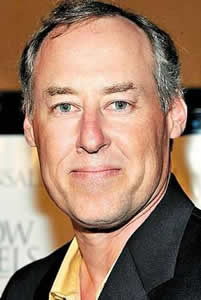
De Amerikaanse schrijver Stewart O'Nan werd geboren op 4 februari 1961 in Pittsburgh, Pennsylvania. Zie ook alle tags voor Stewart O’Nan op dit blog.


Uit: Songs for the Missing


“Inside, the a/c was cranked so high she wore a t-shirt under her uniform. They poached old nametags they found in the junk drawer under the register. She was Angie, Nina was Sam. They spun on their stools and watched the monitors, punching in the pump numbers and making change. They read heavy, insane fashion magazines and called around to see what was going on later — even though they were on camera too — and fought over whose turn it was to refill the nacho pot. Her timecard was in its slot, the clock behind it chunking with every minute, a record of her steadiness. She’d been working seven days a week since graduation and hadn’t missed a shift. Later the police would call this strict pattern a contributing factor. Secretly she was proud of it. She’d never been so determined. She’d never had a reason before.

The Conoco was an oasis of light, drawing cars off the highway like the muffleheads that fluttered against the windows. Drivers came in squinting and rubbing their necks, stopping on the mat inside the door as if this was all new to them, and too much, the bright aisles of candies and chips overloading their brains so they couldn’t read the sign directly in front of them.

They bkinked at her, apologetic. “Where are the–?”

“Straight back.”

Fifty, a hundred times a night. She pointed her whole arm like a ghost.

“It’s true,” Nina said. “The more you drive, the dumber you get.”

“Thank you, thank you, Sam I am.”

The living death had bad breath. They bought coffee and soda and water, cigarettes and gum, Tootsie Pops and jerky, anything to get them to the next stop. In line they nodded their heads and mouthed the lyrics to the dinosaur pop that played endlessly inside and out, a fiendish commercial-free satellite feed pieced together, it seemed, by U2 and the Doobie Brothers.”


 1330031-e9ed7d34dbd231f051c4e2badfbfa8de.jpg

Stewart O'Nan (Pittsburgh,  4 februari 1961)


De Nederlandse dichter en schrijver Louis Ferron werd op 4 februari 1942 geboren in Leiden. Zie ook alle tags voor Louis Ferron op dit blog.


Uit: Tinpest


“Kent u de Dorotheeërgasse? Daar komt een officier als Lauersperg eerst goed tot zijn recht. Die straat: een streng gelede woekering van architraven en timpanen, gebeiteld in grauwe zandsteen. Een barokke pracht die Grieks in haar eenvoud wil zijn en van een voornaamheid die niettemin de indruk wekt dat men zich voor een Berlijnse kapperszaak bevindt. Geen sprankje licht heeft in die straat ooit het plaveisel bereikt. Toch babbelen en kirren de passerende dames, op weg naar theesalon of modezaak, er alsof ze door de Augarten flaneren of in het park van de Belvédère. De pastelkleurige, dan wel sneeuwwitte parasols in lichte, kokette draaiing boven hun hoofden, de lange japonnen met de linkerhand en op kniehoogte net even boven het plaveisel geheven.
Het zijn maar beelden uit een oud boek. Maar wie het ooit heeft ingezien, zullen de gravures en lithografie‰en voor eeuwig... Ach, wat zal men metaforen te hulp roepen waar de pijn knaagt? Liever houde men de blik op Lauersperg gericht die, alle metaforiek omzeilend, zijn nuchtere weg door het leven van zijn tijd ging.
Daar zag hij bijvoorbeeld de vrouw van overste Zaremba met haar vriendin. Rechterhand aan de kepie. En vervolgens niet de burgerlijke buiging voorwaarts, maar de rug daarentegen juist extra gestrekt, voorzover dat bij een in het boksen bedreven officier als Lauersperg nog mogelijk was. Geen uitbundige of familiaire groet, o nee, al had men op bals en soirees menige blik gewisseld. Een kort 'mevrouw overste' en dan een stijve hoofdknik naar de vriendin zodat met het aangename gevoel ervoer van de stijve, staande kraag die als een mes in het vlees onder de kin sneed.
De vreugden van het militaire bestaan werden niet uitsluitend op het slagveld of tijdens de manoeuvres ervaren.”
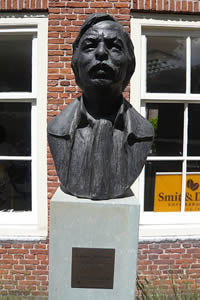


 1330031-91872f9e932801f67d548a46a1c00bea.jpg

Louis Ferron (4 februari 1942 – 26 augustus 2005)

Borstbeeld door Bart Holt in Haarlem 


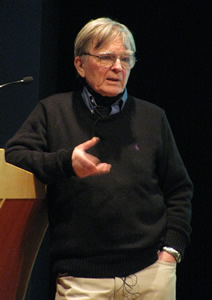
De Amerikaanse schrijver Robert Coover werd geboren op 4 februari 1932 in Charles City, Iowa. Zie ook alle tags voor Robert Coover op dit blog.


Uit:  Noir


“At the door, Michiko, one of the local whores, comes over to flirt with you. Hey, Phil-san, she whispers, wrapping her parchmenty arms around your neck. She uses a body powder that makes you think of an airless hothouse. She looks like she is dressed from head to toe in a densely patterned body stocking, but she is actually wearing only her skin and a thong—if that’s not a tattoo, too. She leans close to your ear as though to nibble it and whispers: Go out back door, Phil-san. Somebody waiting for you in front. C’mon, baby, she says more loudly, reaching into your pants. Quickie-quickie? Michiko love you!

Michiko was not always a suffocatingly perfumed bag of old painted bones. She had a certain enigmatic Eastern aura when she was younger and worked the snazzier joints. Before that, while she was still just a kid in schoolgirl clothes and white cotton panties (white panties used to be a big deal; you miss those times), she had been the moll of a notorious yakuza gangster who had his own portrait tattooed on the inside of her tender young thighs. Where he could keep an eye on things, he said. A rival gang leader kidnapped her and “blinded” the portrait with red splotches, and just for good measure added a mustache and blacked out two of the teeth before returning her to her lover. He also had his own hand, recognizable by its don’t-fuck-with-me dragon tattoo on the back and the superhero code ring on his pinkie, tattooed over her plucked pubes, the middle finger disappearing between her lips. Her lover responded by sending her back to the rival with the dragon tattoo reduced to a simpering please-fuck-me position, the ring finger chopped to a bloody stub, signifying a humiliating three-knuckled yubizume, and the middle finger blackened as though torched by its impertinence. The lover also tattooed Michiko’s ears with haikus celebrating the “black mist” of summer and winter’s “ice-heart,” which was a play on his own name, and inked the circles of a target on her buttocks around the bull’s-eye anus with the phrase “You’re next, asshole!” on the right cheek.”


 1330031-4dee340c5a318b7d36c72abc6cb9212d.jpg

Robert Coover (Charles City,  4 februari 1932)


De Oostenrijkse toneelschrijver Werner Schwab werd geboren in Graz op 4 februari 1958. Zie ook alle tags voor Werner Schwab op dit blog.


Uit: Volksvernichtung oder meine Leber ist sinnlos - Eine Radikalkomödie


“Herrmann:  Eine schändliche Sau bist du, die mich vor der ganzen Welt davondenken will. Aber einmal wird ein Tag auftauchen, der sich gezwungen sehen wird, in eine Kenntnis hereinzunehmen, dass der Maler Herrmann Wurm in Graz sein Licht erblickt hat und dass er das gleich auf der ganzen Weltoberfläche abgebildet hat. Graz...wird man sagen...und wurm...wird man sagen...und Erfinder der persönlichen Lichtstrahlen...wird man sagen...und Kleinstadt: Grosskunst...wird man sagen...und ganz einfach Grazkunst...wird man vor sich voraussagen. Weil eiene richtige Grazkunst, die ist keine Mausescheisse, die von einem Hund gefressen wird, der dann von einem Lastkraftwagen zusammengeführt werden muss. Und die Grazkunst, die ist aber auch schon überhaupt keine angefressene Leber, die aus einer alkoholisierten Leiche herausgefallen ist...beim Leichenwashen. Und schon gar nicht ist die Grazkunst für nichts zu gebrauchen...
Niemand kann mir Graz aus dem Leben herausnehmen.

Frau Wurm: Aber was ist das dann denn für eine Sorte von einer Kunst, die Grazkunst?

Herrmann: Also die Grazkunst...diese Kunstsorte, das ist, wenn die künstlerischen Menschen ihre Gefühle in der gefühlvollen Stadt...zusammenreissen...also wenn eine Kunstsorte sich einen einmaligen Anfang herausnimmt aus den gefühlvollen Grazmenschen. Das ist so, wie wenn der Herr Hausherr sagt, dass er ein Farbbild hereinbrauchen will für das Kinderzimmer von den Kindern von Graz.”
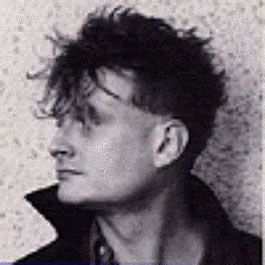


 1330031-2a88941e929c2f5308f63e464875114f.jpg

Werner Schwab (4 februari 1958 - 1 januari 1994)


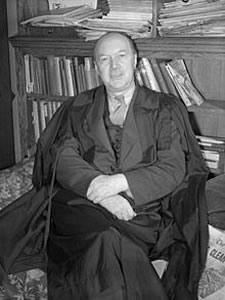
De Canadese dichter E. J. Pratt werd op 4 februari 1882 geboren in Western Bay, Newfoundland. Zie ook alle tags voor E. J. Pratt op dit blog.


Silences


There is no silence upon the earth or under the earth like the silence
    under the sea;
No cries announcing birth,
No sounds declaring death.
There is silence when the milt is laid on the spawn in the weeds and
    fungus of the rock—clefts;
And silence in the growth and struggle for life.
The bonitoes pounce upon the mackerel,
And are themselves caught by the barracudas,
The sharks kill the barracudas
And the great molluscs rend the sharks,
And all noiselessly —
Though swift be the action and final the conflict,
The drama is silent.

There is no fury upon the earth like the fury under the sea.
For growl and cough and snarl are the tokens of spendthrifts who
    know not the ultimate economy of rage.
Moreover, the pace of the blood is too fast.
But under the waves the blood is sluggard and has the same
    temperature as that of the sea.

There is something pre—reptilian about a silent kill.

Two men may end their hostilities just with their battle—cries,
'The devil take you,' says one.
'I'll see you in hell first,' says the other.
 And these introductory salutes followed by a hail of gutturals
    and sibilants are often the beginning of friendship, for who would
    not prefer to be lustily damned than to be half—heartedly blessed?
No one need fear oaths that are properly enunciated, for they
    belong to the inheritance of just men made perfect, and, for all we
    know, of such may be the Kingdom of Heaven.
But let silent hate be put away for it feeds upon the heart of the hater.

Today I watched two pairs of eyes. One pair was black and the
    other grey. And while the owners thereof, for the space of five
    seconds, walked past each other, the grey snapped at the black and
    the black fiddled the grey.
One looked to say — 'The cat,'
And the other— 'The cur.'
But no words were spoken;
Not so much as a hiss or a murmur came through the perfect enamel
    of the teeth; not so much as a gesture of enmity.
If the right upper lip curled over the canine, it went unnoticed.
The lashes veiled the eyes not for an instant in the passing.
And as between the two in respect to candour of intention or
    eternity of wish, there was no choice, for the stare was mutual and
    absolute.
A word would have dulled the exquisite edge of the feeling.
An oath would have flawed the crystallization of the hate.
For only such culture could grow in a climate of silence —
Away back before emergence of fur or feather, back to the unvocal
    sea and down deep where the darkness spills its wash on the
    threshold of light, where the lids never close upon the eyes, where
    the inhabitants slay in silence and are as silently slain.


 1330031-c586c0043697b4702e073deb85fe8503.jpg

E. J. Pratt (4 februari 1882 – 26 april 1964)


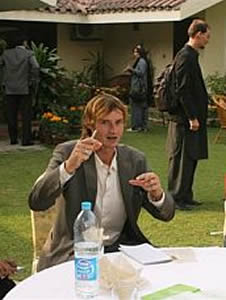
De Duitse schrijver en journalist Norman Ohler werd geboren op 4 februari 1970 in Zweibrücken. Zie ook alle tags voor Norman Ohler op dit blog.


Uit:  Ein großes Stück Wasser (Logbuch)


“Weichsel, km 730. Thorun. Die windschiefen Gassen der Geburtsstadt von Kopernikus öffnen sich zum Fluss und lassen Blicke bis zum mittelalterlichen Domplatz hindurch. Doch hier noch nicht anlegen, sondern das Tageslicht voll nutzen. Festmachen zum Sonnenuntergang am Weichselufer km 699. Fische braten am offenen Feuer. Sternenhimmel. Das Murmeln, Plätschern, Glucksen des Flusses. Niemand hat je hier angelegt. Niemand wird es je wieder tun. So fühlt es sich an.

Weichsel, km 520. Die Skyline von Warschau unwirklich schimmernd am Horizont, der Himmel tomatenrot. Von Minute zu Minute wird die Erscheinung realer, Brücken führen über den Fluss, Straßenbahnen fahren darüber. Jugendliche spielen am Ufer Golf: schlagen die Bälle in den Fluss, stellen dies während der Vorbeifahrt der Aton ein. Drei Tage Landgang. Bis hierhin sei die Weichsel noch einigermaßen befahrbar, erzählt ein Fischer im versteckten Hafen nahe der Altstadt. Über den Abschnitt bis nach Krakau könne er nichts sagen. Es gebe zu wenig Informationen. Er denke, dass der niedrige Wasserstand es unmöglich mache, so weit zu kommen.

Weichsel, km 416. Anders als der Rhein wurde die Weichsel nie begradigt und mäandert durch eine Landschaft, die wirkt wie Europa vor Hunderten von Jahren. Mit Höchstgeschwindigkeit von 40 km/h die Kurven ausfahren, durch, wie es scheint, unberührtes Gebiet. Kein Tempolimit. Keine Kontrollen. Keine Regeln. Und dann mit Vollgas, weil ein Uferzeichen verpasst, in eine Sandbank hinein: ein beinahe erhebendes Gefühl. Das ganze Boot wird sanft vom Sande aufgenommen, gleitet wie auf einer großen Hand. Dann ruckt es böse, Tassen und Teller fliegen vom Tisch, der Honda ist aus.”


 1330031-10b35fbb097660f8d1d6602b23d8aea0.jpg

Norman Ohler (Zweibrücken,  4 februari 1970)]


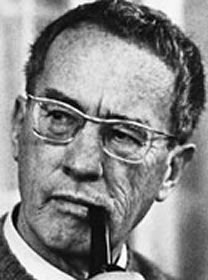
De Duitse schrijver Alfred Andersch werd geboren op 4 februari 1914 in München. Zie ook alle tags voor Alfred Andersch op dit blog.


Uit: Sansibar oder der letzte Grund


“Genauso sind wir in der Lenin-Akademie gesessen, und genauso haben wir gelesen, gelesen, gelesen. Vielleicht haben wir die Arme dabei aufgestützt, vielleicht haben wir Papirossi dabei geraucht - obwohl das nicht erwünscht war -, vielleicht haben wir manchmal aufgeblickt, - aber wir haben den Glockenturm Iwan Weliki* vor dem Fenster nicht gesehen, ich schwöre es, dachte Gregor, so versunken waren wir. So versunken wie er. Er ist wir.

Wie alt ist er? So alt, wie wir waren, als wir genauso lasen. Achtzehn, höchstens achtzehn. Gregor bückte sich tiefer, um dem jungen Mann gänzlich ins Gesicht sehen zu können. Er trägt unser Gesicht, dachte er, das Gesicht unserer Jugend, das Gesicht der Jugend, die ausgewählt ist, die Texte zu lesen, auf die es ankommt. Aber dann bemerkte er auf einmal, daß der junge Mann ganz anders war. Er war gar nicht versunken. Er war nicht einmal an die Lektüre hingegeben. Was tat er eigentlich? Er las ganz einfach. Er las aufmerksam. Er las genau. Er las sogar in höchster Konzentration. Aber er las kritisch. Er sah aus, als wisse er in jedem Moment, was er da lese. Seine Arme hingen herab, aber sie schienen bereit, jeden Augenblick einen Finger auf den Text zu führen, der zeigen würde: das ist nicht wahr. Das glaube ich nicht. Er ist anders, dachte Gregor, er ist ganz anders. Er ist leichter, als wir waren, vogelgleicher. Er sieht aus wie einer, der jederzeit das Buch zuklappen kann und aufstehen, um etwas ganz anderes zu tun.”


 1330031-a0665b84cec0ffc8a8c1f16b6f4c168f.jpg

Alfred Andersch (4 februari 1914 – 21 februari 1980)


Zie voor nog meer schrijvers van de 4e februari ook mijn blog van 4 februari 2011 deel 2.

Geschreven door Romenu om 19:36 Reageer op dit bericht

Georg Trakl, Paul Auster, Johannes Kühn, Andrzej Szczypiorski

De Oostenrijkse dichter Georg Trakl werd op 3 februari 1887 in Salzburg geboren. Zie ook alle tags voor Georg Trakl op dit blog.


De profundis


Es ist ein Stoppelfeld, in das ein schwarzer Regen fällt.
Es ist ein brauner Baum, der einsam dasteht.
Es ist ein Zischelwind, der leere Hütten umkreist.
Wie traurig dieser Abend.


Am Weiler vorbei
Sammelt die sanfte Waise noch spärliche ähren ein.
Ihre Augen weiden rund und goldig in der Dämmerung
Und ihr Schoß harrt des himmlischen Bräutigams.


Bei der Heimkehr
Fanden die Hirten den süßen Leib
Verwest im Dornenbusch.


Ein Schatten bin ich ferne finsteren Dörfern.
Gottes Schweigen
Trank ich aus dem Brunnen des Hains.


Auf meine Stirne tritt kaltes Metall
Spinnen suchen mein Herz.
Es ist ein Licht, das in meinem Mund erlöscht.


Nachts fand ich mich auf einer Heide,
Starrend von Unrat und Staub der Sterne.
Im Haselgebüsch
Klangen wieder kristallne Engel.


Im Winter


Der Acker leuchtet weiß und kalt.
Der Himmel ist einsam und ungeheuer.
Dohlen kreisen über dem Weiher
Und Jäger steigen nieder vom Wald.


Ein Schweigen in schwarzen Wipfeln wohnt.
Ein Feuerschein huscht aus den Hütten.
Bisweilen schellt sehr fern ein Schlitten
Und langsam steigt der graue Mond.


Ein Wild verblutet sanft am Rain
Und Raben plätschern in blutigen Gossen.
Das Rohr bebt gelb und aufgeschossen.
Frost, Rauch, ein Schritt im leeren Hain.


Kaspar Hauser lied
Voor Bessie Loos


Hij had waarlijk de zon lief, die purpur de hemel afdaalde,
De paden van het bos, de zingende lijster
En de vreugde van het groen.


Ernstig was zijn wonen in de schaduw van een boom
En zuiver zijn gelaat.
God sprak een tere vlam tot zijn hart:
O mens!


Stil vond zijn stap de stad in de avond;
De donkere klacht van zijn mond:
Ik wil een ruiter worden.


Hem echter volgden struik en dier,
Huis en schemertuin van witte mensen
En zijn moordenaar zocht naar hem.


Voorjaar en zomer en mooi de herfst
Van de rechtvaardige, zijn stille stap
Langs de donkere kamers van dromenden.
's Nachts bleef hij met zijn ster alleen;


Zag dat sneeuw viel in kale takken
En in de schemerende hal de schim van de moordenaar.


Zilver verzonk het hoofd van de ongeborene.


Vertaald door Frans Roumen


 1329585-331a63aea39a6bf832d669ac738623d6.jpg

Georg Trakl (3 februari 1887 – 4 november 1914)

Een zeer jonge Trakl


De Amerikaanse dichter, schrijver en essayist Paul Auster werd geboren op 3 februari 1947 in Newark, New Jersey. Zie ook alle tags voor Paul Auster op dit blog.


White Nights

No one here,
and the body says: whatever is said
is not to be said. But no one
is a body as well, and what the body says
is heard by no one
but you.

Snowfall and night. The repetition
of a murder
among the trees. The pen
moves across the earth: it no longer knows
what will happen, and the hand that holds it
has disappeared.

Nevertheless, it writes.
It writes: in the beginning,
among the trees, a body came walking
from the night. It writes:
the body's whiteness
is the color of earth. It is earth,
and the earth writes: everything
is the color of silence.

I am no longer here. I have never said
what you say
I have said. And yet, the body is a place
where nothing dies. And each night,
from the silence of the trees, you know
that my voice
comes walking toward you.


1329585-5d12fccc9b7784c3fbaff97eeabffa99.jpg 

Paul Auster (Newark, 3 februari 1947)


De Duitse dichter en schrijver Johannes Kühn werd geboren op 3 februari 1934 in Bergweiler, gemeente Tholey in het Saarland. Zie ook alle tags voor Johannes Kühn op dit blog.


Draußen


In Gesprächen wohn ich nicht gern.

An der Eiche lieber

Meine Schulter,

allen Stämmen zugelehnt die Stirn!

Gras ans Knie mit Schlangenstimmen wispernd,

Käfer, einen Funkenflug

Um mich!


Immer lieb ich den weiten Saal der Ebenen,

darin du gehen kannst

Leidensschritt,

darin du tanzen kannst

Weltglück.

Die Waldwege durch, die Kiesstränge hin,

Gewölbe hoch genug, bis an die Sterne nachts,

daran dich zu stoßen, bist du noch lang nicht

gewachsen.


Zukunft


Ich wollte jetzt,

die Gärten hätten Füße

und würden mit mir gehen

zu Felsenhängen,

wohin ich soll.


Mein vater lacht

Mit heisrer Stimme,

und meine Mutter weint.


Auf meiner Achsel saß der Totenvogel,

den niemand sah.


 1329585-688a5ca50433fed35e01268dd7070030.jpg

Johannes Kühn (Bergweiler, 3 februari 1934)


De Poolse schrijver Andrzej Szczypiorski werd geboren op 3 februari 1928 in Warschau. Zie ook alle tags voor Andrzej Szczypiorski op dit blog.


Uit: Selbstportrait mit Frau (Vertaald door Klaus Staemmler)


“Er hörte jetzt das Rauschen in der Leitung. Warmer, schmutziger Regen floß die Scheiben hinunter. Die Luft roch nach Ruß oder nach einem unbekannten Gift. Dienstag, dachte er. Es ist so sinnlos, daß wir Dienstag haben. Aber auch alles andere war sinnlos. Er hörte deutlich das Rauschen im Hörer.

Ein junger Mann in Jeans und stark abgewetzter Lederjacke stand am nächsten Automaten. Er trug weiße, feuchte Adidasschuhe und hüpfte tänzerisch auf und ab, doch ohne Gefühl für Rhythmus, töricht und gedankenlos, als wollte er seine durchnäßten Füße aufwärmen. Er war rothaarig, hatte kleine, schräg gestellte, böse Augen und schlechte Zähne. Er roch nach Pfefferminze, vielleicht vom Kaugummi, und sprach mit einem singenden Akzent in den Hörer, dabei benutzte er die geheimnisvolle Sprache der ungewaschenen und stumpfsinnigen Auserwählten des Schicksals, unablässig sagte er nu, eigentlich war das fast alles, was er sagte, Kamil war bereit zu schwören, daß sie ebenso antwortete, er vernahm im Hörer des jungen Mannes ihr fernes, gedämpftes nu, so verständigten sie sich in der Sprache der Menschenfresser oder längst ausgestorbener, fossiler Tiere, aber vielleicht hatte er auch die Fähigkeit zu sprechen verloren, weil die anderen immer nu sagten, ein Schlüsselwort, das in ihrer Sprache sehr viel bedeutete, vielleicht sogar alles, nu, sagten beide, nu, Hala, nu, gehen wir, nu, Dzidek, nu, nein, nu, ja, nu, Hala, nu... “


 1329585-f25eca4f5fc695e25937c64611915883.jpg

Andrzej Szczypiorski (3 februari 1928 – 16 mei 2000)


Zie voor nog meer schrijvers van de 3e februari ook mijn tweede en eveneens mijn eerste blog van vandaag.

Geschreven door Romenu om 00:00 Reageer op dit bericht

Lao She, Henning Mankell, Richard Yates, Gertrude Stein, Ferdinand Schmatz

De Chinese schrijver Lao She (pseudoniem voor Shu Qingchun) werd geboren op 3 februari 1899 in Beijing. Zie ook alle tags voor Lao She op dit blog.


Uit: Rickshaw Boy (Vertaald door Shi Xiaoqing)


“Where could I go? Only this was still a problem, not to say other things. Put up at a small inn for the night?  Not work. In the middle of the night with all his clothes he would be losing something, not refer to how terrible lice in the inns. Go to a larger hotel? He had only 5 Yuan with him, which was all his property. Bathhouse?  Couldn't stay over after closing at 12 o'clock. He couldn't go anywhere. He found himself coming into Zhong Hai. On the bridge,  open spaces was around and slices of snow throwed into his eyes. He knew the snow had not stopped almost at this moment, but the woven wool hat has been very wet when he touched the head. No people in the bridge, even pliceman couldn't been seen. Several electric lights appeared like blinked restlessly because of the hitting of the snow. Xiang Zi looked at the snow around,  at a loss in his head.

He stood in the bridge for a long time. The world had little noise, like had been dead. Slices of ashen snow was falling fiercely, it was so hurry and quick like got a chance and wanted to covering the whole world without being known.”

(…)

"Carrying his trifling object he'd...drag along, slowly and listlessly. He might as well keep walking when everyone else had stopped. He might as well stand around when everyone else had started off again...he was even more oblivious to whether he was the same distance from those ahead of him as he was from those behind...he went at his own pace wit his head down as if in a dream, and even more, as if pondering some lofty principle."


 1329579-cce728d8d7888807233eb8a1ef867dfe.jpg

Lao She (3 februari 1899 – 24 augustus 1966)

Onthulling van een bronzen beeld van Lao She in Beijing, 2009 


De Zweedse schrijver Henning Mankell werd geboren in Stockholm op 3 februari 1948. Hij woont afwisselend in Mozambique en in zijn vaderland Zweden. Zie ook alle tags voor Henning Mankell op dit blog.


Uit: The Man From Beijing (Vertaald door Laurie Thompson)


“Frozen snow, severe frost. Midwinter.

Early in January 2006 a lone wolf crosses the unmarked border and enters Sweden from Vauldalen in Norway. A man on a snowmobile thinks he might have glimpsed it just outside Fjällnäs, but the wolf vanishes into the trees heading east before he is able to pinpoint it. In the remote Norwegian Österdalarna Mountains it had discovered a lump of frozen moose carcass, with remnants of meat still clinging to the bones. But that was more than two days ago. It is beginning to feel the pain of hunger and is desperately searching for food.

The wolf is a young male that has set out to find a territory of his own. He continues his way eastward. At Nävjarna, north of Linsell, he finds another moose carcass. For a whole day he stays and eats his fill before resuming his trek east. When he comes to Kårböle he trots over the frozen Ljusnan and then follows the river along its winding route toward the sea. One moonless night he lopes silently over the bridge at Järvsö, then heads into the vast forests that stretch to the coast.

In the early morning of January 13 the wolf reaches Hesjövallen, a tiny village south of Hansesjön Lake in Hälsingland. He pauses and sniffs the air. He detects the smell of blood. He looks around. There are people living in the houses but no smoke rising from the chimneys. His sharp ears can't detect the slightest sound.

But the wolf is in no doubt about the blood. He skulks at the edge of the forest, nose in the air. Then he moves forward, silently, through the snow. The smell comes from one of the houses at the far end of the hamlet. He is vigilant now — with humans around it's essential to be both careful and patient. He pauses again. The smell originates from the back of the house. He waits. Then eventually starts moving once more.”


 1329579-34a5a630490444d622b2497f359e110f.jpg

Henning Mankell (Stockholm, 3 februari 1948)


De Amerikaanse schrijver Richard Yates werd geboren op 3 februari 1926 in Yonkers, New York. Zie ook alle tags voor Richard Yates op dit blog.


Uit: Revolutionary Road


The Players, coming out of their various kitchen doors and hesitating for a minute to button their coats or pull on their gloves, would see a landscape in which only a few very old, weathered houses seemed to belong; it made their own homes look as weightless and impermanent, as foolishly misplaced as a great many bright new toys that had been left outdoors overnight and rained on. Their automobiles didn't look right either--unnecessarily wide and gleaming in the colors of candy and ice cream, seeming to wince at each splatter of mud, they crawled apologetically down the broken roads that led from all directions to the deep, level slab of Route Twelve. Once there the cars seemed able to relax in an environment all their own, a long bright valley of colored plastic and plate glass and stainless steel--KING KONE, MOBILGAS, SHOPORAMA, EAT--but eventually they had to turn off, one by one, and make their way up the winding country road that led to the central high school; they had to pull up and stop in the quiet parking lot outside the high-school auditorium.


 1329579-0cf6dbca609d2f0fe0d14154a81fc485.jpg

Op de set van de film met Kate Winslet en Leonardo DiCaprio


"Hi!" the Players would shyly call to one another.
"Hi! . . ." "Hi! . . ." And they'd go reluctantly inside.
Clumping their heavy galoshes around the stage, blotting at their noses with Kleenex and frowning at the unsteady print of their scripts, they would disarm each other at last with peals of forgiving laughter, and they would agree, over and over, that there was plenty of time to smooth the thing out.”


 1329579-53318954658538d9991af146eb3dd27e.jpg

Richard Yates (3 februari 1926 – 7 november 1992)


De Amerikaanse schrijfster Gertrude Stein werd geboren op 3 februari 1874 in Allegheny (Pennsylvania). Zie ook alle tags voor Gertrude Stein op dit blog.


Stanzas In Meditation: Stanza I


I caught a bird which made a ball
And they thought better of it.
But it is all of which they taught
That they were in a hurry yet
In a kind of a way they meant it best
That they should change in and on account
But they must not stare when they manage
Whatever they are occasionally liable to do
It is often easy to pursue them once in a while
And in a way there is no repose
They like it as well as they ever did
But it is very often just by the time
That they are able to separate
In which case in effect they could
Not only be very often present perfectly
In each way whichever they chose.
All of this never matters in authority
But this which they need as they are alike
Or in an especial case they will fulfill
Not only what they have at their instigation
Made for it as a decision in its entirety
Made that they minded as well as blinded
Lengthened for them welcome in repose
But which they open as a chance
But made it be perfectly their allowance
All which they antagonise as once for all
Kindly have it joined as they mind


 1329579-6ec75dbac2f703c890449110fc51d35a.jpg

Gertrude Stein (3 februari 1874 – 27 juli 1946)

Portret door Andy Warhol, 1980


De Oostenrijkse dichter en schrijver Ferdinand Schmatz werd geboren op 3 februari 1953 in Korneuburg. Zie ook alle tags voor Ferdinand Schmatz op dit blog.


Vorgeben


etwas steuert, immer hin vor mir,
geläufig, halb erwacht, doch stets bedacht,
die andre hälfte zu umspinnen: ganz
- wo es die fäden binden, mustern –


dort spult es ab das garn, gibt vor
und an, weist dieses ein zu schwenken,
nach vorne ab zu wicklen, das kreisen
ein zu schreiben drinnen hinten –


flachst, dass sich die balken biegen
mit den wellen schneiden, binnen,
treiben deren ausgelöste wonnen


ab - zu setzen pflegen sie so schön gebärden,
vor dem, was über allem, grenze wies und schritt,
wo’s war, was ist, und bleibt, was werde


ab heben


etwas läuft, in mir, fasst unten an,
zieht das gar ungelenk hinauf,
bekniet gepflanzt nichts mehr,
entwirft sich - in der mitte glanz –


von oben selbst im blick, dreht plan
quer durch, entwischt dem wurf,
verstreut jedoch - im sprung - das ganze,
wirft alles für den, tiefen, fall


- ab, egal ob ball, egal ob ast,
den fuss vertritt, den hand da hat,
hebt, bar - gewicht verlischt –


bloss ab: von dieser schwere los
entspringt es schreibend dem, was wäre,
wie’s gewesen sein wird, wenn es ist


 1329579-8f41e9fdd51df9019ca246ea96549f28.jpg

Ferdinand Schmatz (Korneuburg, 3 februai 1953)

Geschreven door Romenu om 00:00 Reageer op dit bericht

Michael Scharang, Sarah Kane, James A. Michener, Annette Kolb, Ernst von Wildenbruch

De Oostenrijkse schrijver Michael Scharang werd geboren in Kapfenberg in de provincie Steiermark op 3 februari 1943. Zie ook alle tags voor Michael Scharang op dit blog.


Uit: Charly Traktor


“Er hat im Laufe des Tages mehrmals einen Anlauf genommen, sich auf dieses andere zu konzentrieren. Aber bei jedem Anlauf sind aus der einen Sache mehrere geworden. Er hat die Übersicht verloren. Er sucht eine Ablenkung.

„Wie kommt der Hügel da her?“ Er läuft auf den Schotterkegel, der stellenweise bewachsen ist. Einige Schritte weiter ist noch so ein Hügel. Auf ihm sitzt ein Paar, mit dem Rücken zu Charly Traktor.

Sie wirft den Kopf so weit zurück, daß er glaubt, sie müßte ihn sehen. Er setzt sich. Sie hat eine ländliche Haartracht. Die geflochtenen Haare sind am Hinterkopf zu einem Knoten gedreht. Seine Mutter hatte früher so eine Frisur. Nur glänzten ihre Haare nicht.

Die junge Frau lehnt ihren Kopf gegen den Kopf des Mannes. Der weiße Kragen der Bluse ist über die rote Strickjacke ausgeschlagen.

Charly hofft, daß sie den Kopf wieder zurückwirft. Der Mann neben ihr stützt beide Hände auf dem Schotter auf. Die Hände sieht man nicht, sie sind von den schwarzen Rockärmeln verdeckt. Charly Traktor fragt sich, ob er auch so einen Rock tragen würde, wenn er auf dem Land geblieben wäre. Er streicht über seine Lederjacke. Als er diese Bewegung bemerkt, steckt er die Hand schnell in die Tasche. „Ich komme mir gut vor.“

Er nimmt eine Packung Zigaretten heraus, mit der Öffnung nach unten. Drei Zigaretten fallen zu Boden. Eine rollt den Hügel hinunter. Er holt sie. Als er wieder sitzt, waren die beiden bereits aufgestanden. Er erwartet, daß sie sich nach ihm umdrehen. Sie gehen weg. „Wahrscheinlich haben sie sich schon vorher umgedreht, als ich nicht hingeschaut habe“.


 1329556-32bac6afbb3086b777f0cfe02692897e.jpg

Michael Scharang (Kapfenberg, 3 februari 1943)


De Britse toneelschrijftster Sarah Kane werd geboren op 3 februari 1971 in Essex. Zie ook alle tags voor Sarah Kane op dit blog

Uit: 4.48 Psychosis


A song for my loved one, touching her absence

the flux of her heart, the splash of her smile


In ten years time she’ll still be dead. When I’m living with it, dealing with it, when a few days pass when I don’t even think of it, she’ll still be dead. When I’m an old lady living on the street forgetting my name she’ll still be dead, she’ll still be dead, it’s just


fucking


over


and I must stand alone


My love, my love, why have you forsaken me?


She is the couching place where I never shall lie

and there’s no meaning to life in the light of my loss

Built to be lonely

to love the absent


Find me

Free me

from this


corrosive doubt

futile despair

horror in repose


I can fill my space

fill my time

but nothing can fill this void in my heart


 1329556-83e53b8ccb14ca1c2a70762468c892e8.jpg

Sarah Kane (3 februari 1971 – 20 februari 1999)


De Amerikaanse schrijver James A. Michener werd geboren op 3 februari 1907 in New York. Zie ook alle tags voor  James A.  Michener op dit blog.


Uit: Chesapeake


“His logic was rejected not only by the council of chiefs but also by the common warriors, who felt that for a Susquehannock to pass more than a year in peace would be disgraceful. If their great river had proved an excellent place to live, it must be because their tribe had always fought to protect it, and an old warrior predicted, "Pentaquod, when the day comes that we are afraid to fight, we lose the river."

    He persisted in talking against a meaningless war, and since any who spoke for peace in the lands along this river would always be charged with treason, his opponents started the, rumor that he had been contaminated by the enemy and served as their spokesman. It was recalled that his wife had died young, which increased the likelihood that the gods rejected his arguments.

    To charge him with cowardice was confusing, for he was one of the tallest Susquehannocks in a generation, and they were a tribe of giants. Towering above young men his age, he looked with steady gaze from his great, broad face, darker in color than normal, sure sign of a warrior. This contradiction perplexed children who listened to the accusations against him, and they began to mimic his diffident walk as he moved alone about the edges of the village; soon they would be taunting him openly.

    It was one of these children who drove him to his decision. The little boy had been aping him behind his back, causing much merriment among onlookers, when Pentaquod suddenly turned and seized him, demanding to know why he was behaving so, and the child blurted out, "My father says the council is meeting to punish you" And when Pentaquod looked about the village he realized that the elders were missing, and he knew that the boy was speaking truth.”


 1329556-0477443a00c6287795b2ef40813f2164.jpg

James A.  Michener (3 februari 1907 - 16 oktober 1997)


De Duitse schrijfster Annette Kolb werd geboren op 3 februari 1870 in München. Zie ook alle tags voor Annette Kolb op dit blog.


Uit: Zarastro - Memento


“Am 1. Februar 1917 kam ich gegen Abend defi nitiv nach Bern.

Im Zug – am Fenster – schlief ich zwischen Zürich und Baden auf einige Sekunden ein. Dabei rückten sich Bilder aus meiner Wohnung, aber um ein Drittel vergrößert – die sich also selbst vergrößert hatten –, selbst an einer Wand zurecht. –

Trotz dieser so unvermittelt aufblitzenden Vision wurde die Mutlosigkeit, gegen die ich anzukämpfen hatte, immer drückender, und geradezu trostlos gestaltete sich meine Einfahrt in die Bahnhofhalle.

Es goß so recht von innen heraus, wie nur der Berner Himmel zu gießen versteht. So begibt man sich wohl ins Gefängnis, wie ich in das Haus, um dessen anheimelnder alten Stiege willen ich im zweiten

Stock zwei kleine Zimmer mit einem Alkoven gemietet hatte. Übrigens waren sie noch nicht frei, und indessen wurde mir ein großes niedriges angewiesen, das sofort meine Abneigung erregte: bis auf einen gewaltigen Tisch von wahrhaft tröstlichem Umfang. Er stand mitten in der Stube, ganz auf sich beruhend:

Sieh mein geräumiges Rund, und wie gefällig es ist! Sahst du ein weiteres je?

Bürde nur füglich mir auf, was immer du willst. Ich schaffe noch Platz dir. Na also!

So redete er, halb in Hexametern, halb wie eine alte Kindsfrau zu mir, war immer optimistisch und richtete mich auf.

Das Münster aber, das so gut anhebt und so schlecht verläuft, beschattet und beherrscht den Platz, und die Aussicht hart vor meinen Fenstern ist durch ihn versperrt. Auch mein Herz schlägt hinter Riegeln. Ich bin nicht mit den Illusionen hergekommen wie das erstemal.”


1329556-e0ce4f167e88ccdd695fefdeceedc75d.jpg 

Annette Kolb (3 februari 1870 – 3 december 1967)


De Duitse dichter en schrijver Ernst von Wildenbruch werd op 3 februari 1845 geboren in Beiroet. Zie ook alle tags voor Ernst von Wildenbruch op dit blog.


Reiche Beschäftigung


Abends, wenn ich zur Ruh geh´,

Denk´ich an meine Grete.

Morgens, wenn ich früh aufsteh´,

Mach´ich´s wie abends späte.

Zwischendurch, so am Vormittag,

Denk´ich, was sie wohl treiben mag.

Mittags- aber und Vesperzeit

Sind dem Gedanken an sie geweiht.

Sagt mir nun um des Himmels Willen,

Wo bleibt mir die Zeit, meine Akten zu füllen?

"Ei, so setze die Nacht daran,

Nachts man trefflich schaffen kann!"

Ja, wie sollt´ich die Nacht versäumen?

Muß doch von meiner Grete träumen.


Alt sein heißt...


Alt sein heißt ja nicht schwach sein;
es heißt nur doppelt wach sein
für das, was wahr und echt.

Du lebenslang ein Wächter
des Echten und sein Hegfer,
just dir steht Altsein recht!


 1329556-d312929c29b7426226ed178a3b2f0aab.jpg

Ernst von Wildenbruch (3 februari 1845 – 15 januari 1909)

Geschreven door Romenu om 00:00 Reageer op dit bericht

Meer van Romenu

↑ Terug naar de berichten