Naar de inhoud

Romenu

Over literatuur, gedichten, kunst en cultuur
akke.beakke.be

Berichten van 17 februari 2015 tot 18 februari 2015

Aschermittwoch (Louise Hensel)


Bij Aswoensdag


 1724334-a02c87e44161864ccd1bedd41152e291.jpg
Aschermittwoch door Ernst Hanfstaengel, 1895


Aschermittwoch

»Staub bist du und kehrst zum Staube,
Denk', o Mensch, an deinen Tod!«
Wohl, dies weiß ich, doch mein Glaube
Sieht ein ew'ges Morgenroth.

Sieht ein Land, wo Friedenspalmen
Um des Siegers Scheitel wehn,
Wo umrauscht von ihren Psalmen
Wir der Engel Chöre sehn.

Wo Maria, die Getreue,
Ihr geliebtes Kind uns zeigt,
Wo die Sehnsucht und die Reue
Nun ihr selig Ziel erreicht.

Wo der Vater mit dem Sohne
Und dem heil'gen Geist zugleich
Thront auf einem ew'gen Throne,
Unaussprechlich herrlich, reich.

Wo wir Den, der je gewesen,
Schauen, wie Er ewig war.
O, dort wird mein Herz genesen!
O, dort wird mein Auge klar!


 1724334-bd979e46e34a7de7d4f83a4404aa566e.jpg
Luise Hensel (30 maart 1798 – 18 december 1878)
Portret door Josse Goossens


Zie voor de schrijvers van de 18e februari ook mijn vorige blog van vandaag.

Geschreven door Romenu om 10:38 Reageer op dit bericht

Nick McDonell, Toni Morrison, Robbert Welagen, Bart FM Droog, Maarten Mourik, Huub Beurskens, Gaston Burssens

De Amerikaanse schrijver Nick McDonell werd geboren op 18 februari 1984 in New York. Zie ook alle tags voor Nick McDonell op dit blog.

Uit: The Third Brother

“So Mike is glad when the assignment comes, even though he is very surprised. He had been watching again, and Analect had been standing in conversation with Bishop for nearly ten minutes. Mike had been looking closely through the glass-he sensed the men were angry with one another-when Bishop suddenly turned and opened the door. Mike feared he was caught, but then Bishop waved him into the office and Analect asked if he wanted to go to Bangkok. "Help Tommy with some reporting," as he put it.
Bishop nods slightly at Mike. Bishop is a small man, with fat features and prematurely graying black hair.
"The story, is backpacker kids going to Bangkok to do ecstasy," Analect says. "Just don't get arrested."
"He doesn't want to have to retrieve you," Bishop says.
"It's really just a travel story, is another way to look at it," Analect goes on.
"Just a travel story," Bishop repeats, chuckling.
"You're their age," Analect continues, "the backpackers'. You'll be good at talking to them. Ask questions. It can be your story too. And one other thing I've already explained to Tommy ..."
Mike catches Bishop rolling his eyes.
"... I want you to find Christopher Dorr."
Mike can't place the name.
"He used to do a lot of the investigative pieces Tommy does now," Analect says, looking straight at him, seeming almost to ignore Bishop. "He's been in Bangkok for a while, I think. It'd be good for someone from the magazine to look him up."


 1724321-6b429b21491d3587e0f705d46853e9da.jpg
Nick McDonell (New York, 18 februari 1984)


De Afro-Amerikaansschrijfster Toni Morrison werd geboren op 18 februari 1931 in Lorain, Ohio. Zie ook alle tags voor Toni Morrison op dit blog.

Uit:Song of Solomon

“You can't own a human being. You can't lose what you don't own. Suppose you did own him. Could you really love somebody who was absolutely nobody without you? You really want somebody like that? Somebody who falls apart when you walk out the door? You don't, do you? And neither does he. You're turning over your whole life to him. Your whole life, girl. And if it means so little to you that you can just give it away, hand it to him, then why should it mean any more to him? He can't value you more than you value yourself.”
(…)

“It sounded old. Deserve. Old and tired and beaten to death. Deserve. Now it seemed to him that he was always saying or thinking that he didn't deserve some bad luck, or some bad treatment from others. He'd told Guitar that he didn't 'deserve' his family's dependence, hatred, or whatever. That he didn't even 'deserve' to hear all the misery and mutual accusations his parents unloaded on him. Nor did he 'deserve' Hagar's vengeance. But why shouldn't his parents tell him their personal problems? If not him, then who? And if a stranger could try to kill him, surely Hagar, who knew him and whom he'd thrown away like a wad of chewing gum after the flavor was gone--she had a right to try to kill him too.
Apparently he though he deserved only to be loved--from a distance, though--and given what he wanted. And in return he would be...what? Pleasant? Generous? Maybe all he was really saying was: I am not responsible for your pain; share your happiness with me but not your unhappiness.”


 1724321-748ca5a418f51a58d1c8e8fa7eed6285.jpg
Toni Morrison (Lorain, 18 februari 1931)


De Nederlandse schrijver Robbert Welagen werd geboren in Dordrecht op 18 februari 1981. Zie ook alle tags voor Robbert Welagen op dit blog.

Uit: Verre vrienden

'Als ik de geestelijke staat van die zomers wil beschrijven, kan ik alleen maar iets duns zeggen: ik stelde mezelf voortdurend uit, had spookemoties,dutte in en vergat mijn verlangens. Een droomtoestand slechts onderbroeken door soms met ene gevonden eencentmuntje in mijn hand door de tuin te lopen. Dikwijls vergast ik aan het einde van de dag de weg naar huis en dan sliep ik buiten onder de eik. Ik was een laagje poeder. Pff, een windvlaagje en weg was ik. Dwarrelend door de lucht kwam ik neer op de grond als een schaduw. Ik ben 'achtig', kon ik zeggen. Ik zoek de dunne restruimte in de wereld, ook dat kon ik zeggen. Het kleinste stukje dat zich overal tussendoor uitstrekt. Al die woorden waren heel vanzelfsprekend.' 


 1724321-c9f391b96ab7a2dc1ec9cdaf82fe8e49.jpg
Robbert Welagen (Dordrecht, 18 februari 1981)


De Nederlandse dichter Bart FM Droog werd geboren in Emmen op 18 februari 1966. Zie ook alle tags voor Bart FM Droog op dit blog.


Schoonmaak

Ofschoon meerdere malen
mijn huishoudster het mij
verbood met vieze handen
het toetsenbord te betasten

sloop ik toen zij mijn boeken
in de keuken verbrandde
met ongewassen handen
terug naar het gekuiste bord

en ramde bezeten
letters van vreugd en jolijt
bevrijd van het oude
gespeend van de tijd.


Een bibliotheek spreekt

Dit is geen wand, maar wijze
om hoger te komen dan daar

waar kometen en sterren jagen
voor waaghalzen en dwazen

is dit geen blinde muur
noch doodlopende weg

dit is de schulp van weten
opgericht uit kalk van wijsheid

gegeseld door regen en vlagen
van vandalen, waan en wind

koppig en onweerstaanbaar
ben ik de weg - betreed me.


 1724321-e1229eb8a395725b95b0fa23679844d3.jpg
Bart FM Droog (Emmen, 18 februari 1966)


De Nederlandse dichter, publicist en diplomaat Maarten Mourik werd geboren in Streefkerk op 18 februari 1923. Zie ook alle tags voor Maarten Mourik op dit blog.


Droogbloemen

Zij versiert het plafond van haar keuken
met bossen gedroogde bloemen:
hortensia, guldenroede,
kogeldistel, wilde bertram;
en kruiden: lavendel, marjo;ijn,
thijm, hysop en rozemarijn.

Vervaalde kleuren, vervaagde geuren;

en zij denkt aan hun bloeiende liefde:
zou die ooit vervalen, vervagen?


Wassenaar

Woekerend regenwoud,
met hier en daar
een open plek
waar het luipaard
de buffel bespringt,
terwijl, veilig verschanst,
een apentroep protesteert.
Ook:
dichtgeslijmd aquarium,
waar exotische vissen
elkaar beloeren
vanachter groene
gordijnen van algen;
wie zich blootgeeft
is er geweest.


 1724321-e9dfb43143d2b548ad8a1a3e65d1c918.jpg
Maarten Mourik (18 februari 1923 - 30 september 2002)


De Nederlandse dichter,vertaler en schilder Huub Beurskens is geboren in Tegelen op 18 februari 1950. Zie ook alle tags voor Huub Beurskens op dit blog.


Als er geen licht meer door linnen dringt

‘Weet je hoe je kunt zien wanneer iets goed geschilderd is?’
vroeg mijn oom in zijn hobbykamer, waar hij zijn Meer bij
zonsondergang met de voorkant tegen de middagzon hield.
‘Als er geen licht meer door het linnen dringt.’ Ik draaide

de ansicht om die als voorbeeld had gediend: Camping
Seeperle, Bodensee, en wist opeens dat ik liefst elk gedicht
met sinterklaasrijm wilde schrijven, inhoudelijk haast zonder
gewicht, in de hoop – ‘We kwamen er vaak, je tante en ik’

– dat er vanzelf iets in sloop en daar bleef waar geen vinger
achter te krijgen is, zoals ofschoon je engel je niet mis
te verstaan zijn Eden uit gewezen heeft, de herinnering

aan zijn meisjesgelaat, dat een en al buiten was zo zonder
noodzaak van een binnen, dat je aldoor hoopt het weer
te zien wanneer ooit geen zicht meer door linnen dringt.


 1724321-e361fca71796447bac715cf537821ad6.jpg
Huub Beurskens (Tegelen, 18 februari 1950)


De Vlaamse dichter en schrijver Gaston Burssens werd geboren in Dendermonde op 18 februari 1896. Zie ook alle tags voor Gaston Burssens op dit blog.


Zeven fabels

Un chat, nommé Rodilardus
Faisait de rats telle déconfiture,
Que l'on n'en voyait presque plus,
Tant il en avait mis dedans la sépulture.
Jean de la Fontaine.

I
De krekel en de mier
De zon schuift naar de verte
naar alle verten schuiven zonnen
de verre zon van verlangen
de zon van ver verlangen
't verlangen naar een verre zon
naar alle verre zonnen
 
Dit is een stichtelike parabel
en beter dan wat goede sier
is deze fabel
van de krekel en de mier


II
De kikvors die een os wou zijn
De wei ligt aan de zoom van 't bos
De hoeve staat in de wei
Hier leggen de vogels een purperen ei
in 't gele mos
 
Ik wenste dat het mos nu purper was
en groen het ei als gras
en het gras nu blauw werd als de lucht
en de lucht één stil gerucht
 
Als ik nu nog het bos kon zijn
en jouw haar van mos kon zijn
dan was de liefde liefdeling
een kikvors die een os kon zijn


 1724321-e9166c4f985ff367e6c10977a1948baf.jpg
Gaston Burssens (18 februari 1896 – 29 januari 1965)


Zie voor nog meer schrijvers van de 18e februari ook mijn blog van 18 februari 2012 deel 1 en eveneens deel 2.

Geschreven door Romenu om 10:24 Reageer op dit bericht

Charlotte Van den Broeck


Onafhankelijk van geboortedata

De Vlaamse dichteres Charlotte Van den Broeck werd in 1991 geboren in Borgerhout. Ze studeert woordkunst aan het Conservatorium van Antwerpen. Van den Broeck stond in 2013 in de top honderd van de Turing Gedichtenwedstrijd en won een plek in de finale van DichtSlamRap. In 2015 verscheen bij De Arbeiderspers haar debuut Kameleon met beeldende, verhalende gedichten dat als een van de beste debuutbundels van het jaar werd betiteld.


Kameleon

Ik spreek in een slepende melodielijn van ‘hier’ en ‘nu’ en ‘blijf’
herhaal dit zo vaak tot het schuurt
tot je me terug in je mond rolt, me onuitgesproken
op je deinende tong legt, zachtjes
zoals kleine meisjes met overgewicht zachtjes
stuiteren bij het lopen.
En ik wil dat je me opnieuw zegt, dat je niet kan ophouden mij te zeggen
dat ik uit de holte van je mond breek
en je me nieuwe namen geeft, de verkeerde
zoals ‘lief’ en ‘klein’ en ‘traag’
dat ik me daarnaar ga gedragen als een geconditioneerde hond,
voortaan mijn borsten bedek
als je onverwachts de badkamer binnenkomt.
Laten we ergens tussen tong en tanden
analoge liefde in dit hoofdkussen liegen.
Misschien schieten we elkaar alsnog te binnen.
Misschien herinneren we ons de plek
waar het schudden begon
en we het ritme niet meer vonden.


 1872749-d66a8ad85a9520d490d0f5d2b1bb362f.jpg
Charlotte Van den Broeck (Borgerhout, 1991)

Geschreven door Romenu om 00:00 Reageer op dit bericht

Soir de carnaval (Jules Laforgue)


Bij Carnaval


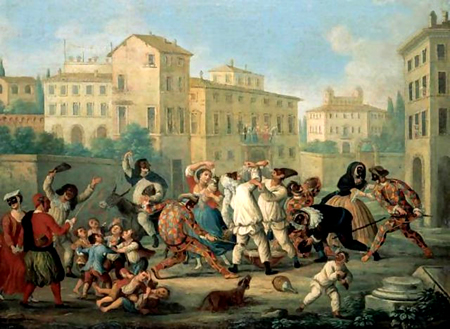
 1723949-8f089f544b0c463a9863980cf3712c63.jpg
Carnavalsscene, toegeschreven aan Marco Marcola (1740–1793)


Soir de carnaval

Paris chahute au gaz. L'horloge comme un glas
Sonne une heure. Chantez! dansez! la vie est brève,
Tout est vain, -- et, là-haut, voyez, la Lune rêve
Aussi froide qu'aux temps où l'Homme n'était pas.

Ah! quel destin banal ! Tout miroite et puis passe,
Nous leurrant d'infini par le Vrai, par l'Amour;
Et nous irons ainsi, jusqu'à ce qu'à son tour
La terre crève aux cieux, sans laisser nulle trace.

Où réveiller l'écho de tous ces cris, ces pleurs,
Ces fanfares d'orgueil que l'Histoire nous nomme,
Babylone, Memphis, Bénarès, Thèbes, Rome,
Ruines où le vent sème aujourd'hui des fleurs ?

Et moi, combien de jours me reste-t-il à vivre ?
Et je me jette à terre, et je crie et frémis
Devant les siècles d'or pour jamais endormis
Dans le néant sans cour dont nul dieu ne délivre!

Et voici que j'entends, dans la paix de la nuit,
Un pas sonore, un chant mélancolique et bête
D'ouvrier ivre-mort qui revient de la fête
Et regagne au hasard quelque ignoble réduit.

Oh! la vie est trop triste, incurablement triste!
Aux fêtes d'ici-bas, j'ai toujours sangloté :
« Vanité, vanité, tout n'est que vanité! »
-- Puis je songeais : où sont les cendres du Psalmiste?


 1723949-f0c0e77858e1bb94352ef7a791b271df.jpg
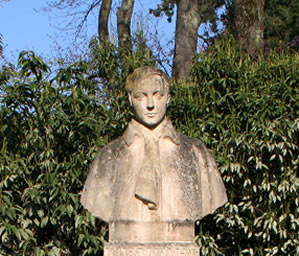
Jules Laforgue (16 augustus 1860 - 20 augustus 1887)
Borstbeeld in Tarbes


Zie voor de schrijvers van de 17e februari ook mijn vorige blog van vandaag.

Geschreven door Romenu om 11:09 Reageer op dit bericht

Shahrnush Parsipur, Sadegh Hedayat, Yevgeni Grishkovetz, Mo Yan,Frederik Hetmann, Emmy Hennings

De Iraanse schrijfster Shahrnush Parsipur werd geboren op 17 februari 1946 in Teheran. Zie ook alle tags voor Shahrnush Parsipur op dit blog.

Uit: The Gentlemen (Vertaald door Farzin Yazdanfar)

“Mr. Habibi: What should we look at? I don't get it.
Mr. Nemati: He's right, dear. We should look around. We just talk. We've been talking for 2500 years.**
Mr. Tahmooresi: According to history, 2800 years. I don't understand why we're insisting on 2500 years. Humanity has existed for a million years.
Mr. Habibi: Not humanity, 'humans'.
Mr. Tahmooresi: 'Humanity' is symmetrical with 'human'. One is meaningless without the other.
Mr. Habibi: But it's correct to say 'human'. For instance, Dr. Barnard,*** who performs heart transplant operations, replaces a human being's heart; he doesn't replace humanity's heart.
Mr. Tahmooresi: You're just playing with words. Well, if Dr. Barnard can change the heart of human beings, he'll somehow be able to change the heart of humanity. Won't he?
Mr. Nemati: But let's be honest. The question of humanity aside, Dr. Barnard seems to have started a good business. There's nobody to ask him what the fuss is about.
Mr. Tahmooresi: I really like Nemati.
He never lets the argument end up with a quarrel. I was once a soldier serving in the army in Kurdestan. I mean I wasn't a soldier. I was higher in rank, I was a lieutenant...
Mr. Habibi: This is how they fool people. They think that if they give you a couple of badges and promote you to a higher rank, they have the right to bully you. I don't understand the logic behind it. Why do they waste two years of one's life?
Mr. Tahmooresi: It's obvious. If a war breaks out, there should be some people to fight. After all, how would a war be possible without soldiers?
Mr. Nemati: I don't understand at all what the real purpose of war is. I read somewhere that war isn't part of man's nature. Man invented war.
Mr. Habibi: Man invented God, too.”
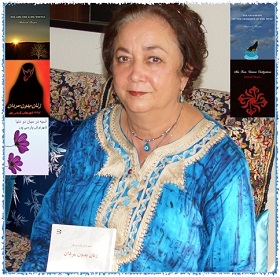
 

 1723946-f1db50db728f9d50e9ce14a8dc4a7563.jpg
Shahrnush Parsipur (Teheran, 17 februari 1946)


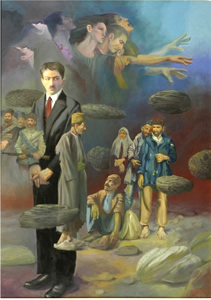
De Iraanse schrijver Sadegh Hedayat werd geboren op 17 februari 1903 in Teheran. Zie ook alle tags voor Sadegh Hedayat op dit blog.

Uit: The Silent Language of a Donkey at the Time of Death (Vertaald door Farzin Yazdanfar)

“Ah! My body is shuddering from pain. This is my reward for all the services I have done for this ruthless, cruel two-legged animal. Today is my last day, and this is my only consolation! After having lived a life full of hardship, suffering and trouble, after having endured unbearable loads, repeated blows from stick and chain and the curses of passers-by, thank God that I am bidding farewell to this dreadful life.
Young Hedayat
Here is Shemiran Road. Today my legs were crushed in a car accident because of my master's carelessness. That is why I am in this situation. After beating me and using foul language, they dragged my wounded body to the road side and left me there - alone. Perhaps they had forgotten that they could still use my horseshoes and hide! They seemed to have lost hope in me.
Will they bring me food in time? No... I have to die in great torment and hunger because I am no longer any use to them.
Ah! The pain is getting more severe and blood is still running from my wounds. What kind of beast is this human being who has dominated us, made our lives shameful, disgraceful and full of suffering and hardship, hurt our natural, frank and friendly feelings, constantly wounded our bodies, and made our lives unpleasant and deplorable. On the surface, he looks similar to us; and, like us, he finally dies. In this respect, there seems to be no difference between us; however, he seems to be made of wood and stone because he whips us as if we had no feelings. If he could feel pain, he would have mercy on us.
These torture instruments that human beings use are unnatural. They themselves have made them. It is sometime since societies called "Humane Societies" have been established in Europe and the United States to defend the rights of animals. Specific laws have been enacted to defend the rights of animals and to stop human beings' cruelty and unjust dealings towards them. Are those who belong to these societies the same as these beasts? Impossible! If they were the same, their hearts could not be made of stone.”
 

 1723946-78cd66bb02f8ca451fae6bc9485460f0.jpg
Sadegh Hedayat (17 februari 1903 – 9 april 1951)
Portret door Shahab Mousavizadeh, 2008


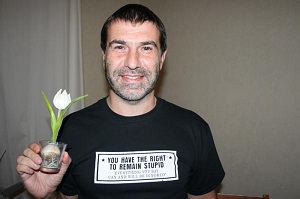
De Russische schrijver, regisseur en acteur Yevgeni Grishkovetz werd geboren op 17 februari 1969 in Kemerovo. Zie ook alle tags voor Yevgeni Grishkovetz op dit blog.

Uit:How I Ate the Dog

“I remember how we traveled seven days from the “Taiga” station to the Vladivostok station on a passenger/mail train.  We traveled slowly, stood at each crossing, and I was grateful to the railroad workers for these tiny delays….  We were going…, and interestingly, you could be going anywhere, to the east, to the south, to the north, and the whole time it would be the exact same scenery, in the sense that, it changes, of course, but the feeling remains that it’s the exact same: This means not very thickly growing birch trees, those uniformly spaced white-black trees, everywhere….  Well, in general, the kind of scenery, looking at which a Russian is obligated to say: “My God… what beauty!”  It happens like this: The Russian has woken up, comes out from the sleeping compartment into the corridor of the wagon, on his shoulders hangs a towel, like so, in his hand a toothbrush with toothpaste already on it, he’s a bit blinded by the morning light (in the compartment it had been very dark), he stops at the window, like so, holding onto the handrail.  In the corridor the rattle of the train is stronger.  Someone draws water from the tea urn.  The train: tuduk-tuk-tuk, tuduk-tuk-tuk.  The person who has just woken up: “Ssssoooo, where are we by now?”  The person with hot water in his mug, swaying with concentration, slowly walking and because of this swaying even more, says: “Who knows…”
The person who has just woken up: “Yeah?! Well, all the same, what beauty…!” Tuduk-tuk-tuk, tuduk-tuk-tuk…
Two sailors took us, they wore white dress uniforms and really looked after their appearance.  Both were short, one had a moustache that he really loved and obviously was very proud of, you couldn’t make it out immediately, but if you so desired, it wasn’t hard to count all the tiny hairs he had on his upper lip, and the other was, I for some reason recall, from Tambov, he was bowlegged and right about here he wore a medal “For faraway deployment.”
 

 1723946-e928f7f069d8c30dc96ad8bbed2cb096.jpg
Yevgeni Grishkovetz (Kemerovo, 17 februari 1969)


De Chinese schrijver Mo Yan werd geboren op 17 februari 1955 in Gaomi in de provincie Shandong. Zie ook alle tags voor Mo Yan op dit blog.

Uit: Shifu, You'll Do Anything for a Laugh (Vertaald door Howard Goldbaltt)

“Just then a white Jeep Cherokee drove in the gate honking its horn, seizing the attention of the people fighting to read the layoff list; they all turned to stare at the Jeep, which looked as if it had just come back from a long, muddy trip. The clamor died down as dazed expressions showed on the people's faces. The Jeep looked a little dazed too, its horn suddenly silent, the engine sputtering, the tailpipe spitting out puffs of exhaust. It was like a wild beast that sensed danger. Its gray eyes stared as they fearfully sized up the situation. At roughly the same time it decided to back out through the gate a chorus of shouts erupted from the workers, whose legs got the message, and in no time the Jeep was surrounded. It tried to break free, lurching forward and backward a time or two, but it was too late. A tall, muscular young man with a purple face — Ding Shikou saw that it was his apprentice, Lü Xiaohu — bent down, opened the car door, and jerked the as**sistant manager in charge of supply and marketing right out of his seat. Curses rained down on the man's head, translucent gobs of spittle splattered on his face, which by then was a ghostly white. His greasy hair fell down over his eyes as he clasped his hands in front of his chest, bent low at the waist, and bowed, first to Lü Xiaohu, then to the rest of the crowd. His lips were moving, but whatever he was trying to say was drowned out by the threatening noises around him. Ding couldn't make out a single word, but there was no mistaking the wretched look on the man's face, like a thief who'd been caught in the act. The next thing he saw was Lü Xiaohu reach out to grab the as**sistant manager's colorful necktie, which looked like a newly-weds’ quilt, and jerk it straight down; the as**sistant manager disappeared from view, as if he'd fallen down a well.“

 

 1723946-b9ef6e4c46a7edfdf6ce65d9b30437aa.jpg
Mo Yan (Gaomi, 17 februari 1955)


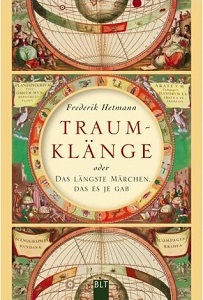
De Duitse schrijver Frederik Hetmann (eig. Hans-Christian Kirsch) werd geboren op 17 februari 1934 in Breslau. Zie ook alle tags voor Frederik Hetmann op dit blog.

Uit: Traumklänge

„Er hatte die vergangenen Wochen über „Herman Melville in New York“ recherchiert und dann für das „New York Times Magazine“ einen Essay von acht Schreibmaschinenseiten geschrieben. Der Artikel war abgelehnt worden. Sie hatten ihn zwar bezahlt, und am Vormittag hatte er sich das Geld an der Kasse abgeholt, aber er fühlte sich trotzdem in seinem Selbstvertrauen erschüttert.
Wie immer, wenn Izaak sich nicht wohl fühlte und es für ihn nichts zu tun gab, ging er ins Hayden Planetarium. Neuerdings hieß es Rose Center und Gottman Hall of Planet Earth, aber für ihn blieb es das Hayden.
Wenn er dort saß, kam er sich vor, als treibe er schwebend im Universum, und er vergaß allen Kummer dieser Welt. Er hörte kaum hin, wenn die Lautsprecherstimme erklärte wie Rote Riesen und Schwarze Löcher entstehen. Es ging ihm nicht um Wissen und Information. Es war diese Illusion, der Erde und ihrer Schwerkraft entrückt zu sein und sich in einem Raum zu befinden, der so unendlich groß war, dass sein Ende unvorstellbar wurde.
An diesem Tag lief ein Programm über den Halley’schen Kometen.
In die Kuppel wurde eine ungewöhnliche Aufnahme aus dem Jahr 1910 projiziert. Man sah den langen weißen Schweif des Kometen, der sich etwa so ausnahm, wie sich Izaak als Kind ein Gespenst vorgestellt hatte, dazu noch Tausende von Sternen als winzige Punkte und am linken unteren Rand vergrößert die Venus. Izaak fühlte sich plötzlich von einer Hand berührt, die wohl zu der Person gehören musste, welche neben ihm saß. Eine sanfte weibliche Stimme sagte:
„Wenn wir aufs gerade Wohl ins All geworfen würden, stünden die Chancen auf oder auch nur nahe einem Planeten landen, nicht einmal eins zu m10/33, eine 10 mit 33 Nullen. Wussten Sie das?”
 

 1723946-79f62d961f279502744e26449102a27b.jpg
Frederik Hetmann (17 februari 1934 – 1 juni 2006)
Cover


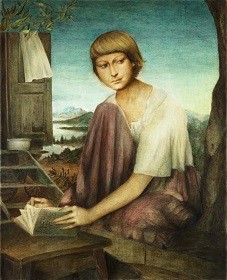
De Duitse dichteres, schrijfster en caberetiere Emmy Hennings werd geboren op 17 februari 1885 in Flensburg. Zie ook alle tags voor Emmy Hennings op dit blog.


Wie Kinder sind wir hilflos

Wie Kinder sind wir hilflos,die nicht wissen,
Ob sie im Diesseits oder Jenseits gehen.
Vor hohen Fenstern sieht man scheu uns stehen.
Man scherzt mit uns. Doch schweigen wir beflissen.

Denn: wenn wir gingen –würde man uns missen?
Und so beschleicht uns nur auf leisen Zehen
Ein Heimweh, mit dem Sommer zu verwehen
Und zu zerrinnen mit den Dämmernissen.

O, man war wohl besorgt, man war bemüht,
Mit manchen Schätzen uns vertraut zu machen.
Um unsere hellen Lippen aber zieht

Ein ängstlich Fremdsein. Unsere überwachen,
Erstaunten Augen sind der Nähe müd.
Auf weiter Fläche grüßen sie den Nachen…


Mädchen am Kai

Hab keinen Charakter, hab nur Hunger,
Ich, Passagier im Zwischendeck des Lebens,
Geliebt und gehasst hab ich vergebens,
Und jeden Abend auf der Lunger.
Und diese Kunst, die geht nach Brot.
Und kann man sterben denn vor Scham?
Ich bin so müde, lendenlahm,
Und dennoch, Zähne gesund, mein Mund ist rot.
Madonna, lass mich fallen in tiefen Schacht.
Nur einmal noch behütet sein.
Lieb mich von allen Sünden rein.
Sieh, ich hab manche Nacht gewacht!
 

 1723946-d300efab91046c73eaa1a9c2be360fc5.jpg
Emmy Hennings (17 februari 1885 – 10 augustus 1948)
Portret door Bernhard Brungs, 2008


Zie voor nog meer schrijvers van de 17e februari ook mijn blog van 17 februari 2012 deel 2 en eveneens mijn blog van 17 februari 2011 deel 2 en eveneens deel 3.


Geschreven door Romenu om 10:56 Reageer op dit bericht

Meer van Romenu

↑ Terug naar de berichten