Romenu is een blog over gedichten, literatuur en kunst Maar Romenu is ook een professionele freelance vertaler Du-Ne en Ne-Du http://www.roumen-vertalingen.nl/
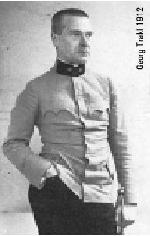
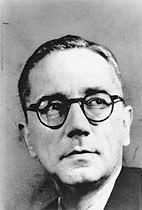
Georg Trakl werd op 3 februari 1887 in het conducteurshuis aan de Waagplatz 2 in Salzburg geboren. Zijn vader, Tobias Trakl, was een handelaar in ijzerwaren en zijn moeder, die ook psychische problemen had, was Maria Catharina Trakl, (meisjesnaam Halik). Voorts had hij nog drie broers en drie zussen. Margarethe (doorgaans Grethe genoemd) stond hem het naast, zelfs zodanig dat sommigen een incestueuze verhouding vermoeden. Zijn jeugd bracht hij door in Salzburg. Vervolgens bezocht hij van 1897 tot 1905 het humanistische gymnasium. Om toch een academische opleiding te kunnen volgen, werkte hij tot 1908 in de praktijk bij een apotheker. Sommigen vermoedden dat hij dit vooral deed om zichzelf opiaten te kunnen verschaffen. Bij het uitbreken van WO I werd Trakl als medicus naar het front in Galicië (heden ten dage in Oekraïne en Polen) gestuurd. Zijn gemoedsschommelingen leidden tot geregelde uitbraken van depressie, die verergerd werden door de afschuw die hij voelde voor de verzorging van de ernstig verwonde soldaten. De spanning en druk dreven hem ertoe een suïcidepoging te ondernemen, welke zijn kameraden nochtans verhinderden. Hij werd in een militair ziekenhuis opgenomen in Kraków, alwaar hij onder strikt toezicht geplaatst werd.Trakl verzonk daar in nog zwaardere depressies en schreef Ficker om advies. Ficker overtuigde hem ervan dat hij contact moest opnemen met Wittgenstein, die inderdaad op weg ging na Trakls bericht te hebben ontvangen. Op 4 november 1914, drie dagen voordat Wittgenstein aan zou komen, overleed hij echter aan een overdosis cocaïne
Paul Celan
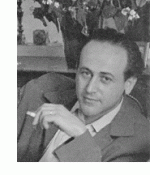
Paul Celan werd onder de naam Paul Antschel op 23 november 1920 geboren in Czernowitz, toentertijd de hoofdstad van de Roemeense Boekovina, nu behorend bij de Oekraïne. Paul Celans ouders waren Duitssprekende joden die hun zoon joods opvoedden en hem naar Duitse christelijke scholen stuurden. In 1942 werden Celans ouders door de Duitse bezetter naar een werkkamp gedeporteerd en daar vermoord. Hijzelf wist aanvankelijk onder te duiken, maar moest vanaf juli 1942 in een werkkamp dwangarbeid verrichten. Celan overleefde de oorlog. Via Boekarest en Wenen vestigde Celan zich in 1948 in Parijs. Daar was hij werkzaam als dichter, vertaler en doceerde hij aan de prestigieuze Ecole Normale Supérieure. Vermoedelijk op 20 april 1970 beëindigde hij zijn leven zelf door in de Seine te springen.
Gerard Reve
Gerard Reve over: Medearbeiders ”God is in de mensen, de dieren, de planten en alle dingen - in de schepping, die verlost moet worden of waaruit God verlost moet worden, door onze arbeid, aangezien wij medearbeiders van God zijn.” Openbaring ”Tja, waar berust elk godsbegrip op, elke vorm van religie? Op een openbaring, dat wil zeggen op een psychische ervaring van zulk een dwingende en onverbiddelijke kracht, dat de betrokkene het gevoel heeft, niet dat hij een gedachte of een visioen heeft, maar dat een gedachte gedachte of visioen hem bezit en overweldigt.”
Simon Vestdijk
Simon Vestdijk (Harlingen, 17 oktober 1898 – Utrecht, 23 maart 1971) was een Nederlands romancier, dichter, essayist en vertaler. Zijn jeugd te Harlingen en Leeuwarden beschreef hij later in de Anton Wachter-cyclus. Van jongs af aan logeerde hij regelmatig bij zijn grootouders in Amsterdam, waar hij zich in 1917 aan de Universiteit van Amsterdam inschrijft als student in de medicijnen. Tijdens zijn studie die van 1917 tot 1927 duurde, leerde hij Jan Slauerhoff kennen.Tot 1932 is hij als arts in praktijken door heel Nederland werkzaam. In 1932 volgt zijn officiële schrijversdebuut met de uitgave van de bundel Verzen in De Vrije Bladen. Doorslaggevend voor Vestdijks uiteindelijke keuze voor de literatuur is zijn ontmoeting in 1932 met Eddy Du Perron en Menno ter Braak. Deze ontmoeting had tot resultaat dat hij redactielid werd van het tijdschrift Forum Kort daarop, in 1933, wordt zijn eerste novelle, De oubliette, uitgegeven. In hetzelfde jaar schrijft hij Kind tussen vier vrouwen, dat, eerst geweigerd door de uitgever, later de basis zal vormen voor de eerste drie delen van de Anton Wachter-romans. In 1951 ontvangt Vestdijk de P.C. Hooftprijs voor zijn in 1947 verschenen roman De vuuraanbidders. In 1957 wordt hij voor het eerst door het PEN-centrum voor Nederland voorgedragen voor de Nobelprijs voor de Literatuur, die hij echter nooit zal krijgen. Op 20 maart 1971 wordt hem de Prijs der Nederlandse Letteren toegekend, maar voor hij deze kan ontvangen overlijdt hij op 23 maart te Utrecht op 72-jarige leeftijd. Vestdijk was auteur van ca. 200 boeken. Vanwege deze enorme productie noemde de dichter Adriaan Roland Holst hem 'de man die sneller schrijft dan God kan lezen'. Andere belangrijke boeken van Simon Vestdijk zijn: "Kind van stad en land" (1936), "Meneer Visser's hellevaart" (1936), "Ierse nachten" (1946), "De toekomst de religie" (1947), "Pastorale 1943" (1948), "De koperen tuin" (1950), "Ivoren wachters" (1951), "Essays in duodecimo" (1952) en "Het genadeschot" (1964).
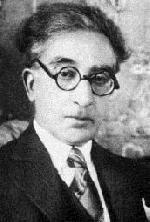
K.P. Kavafis K.P. Kavafis werd als kind van Griekse ouders, afkomstig uit Konstantinopel, geboren in 1863 in Alexandrië (tot vandaag een Griekse enclave) waar hij ook het grootste deel van zijn leven woonde en werkte. Twee jaar na de dood van zijn vader verhuist het gezin in 1872 naar Engeland om na een verblijf van vijf jaar naar Alexandrië terug te keren. Vanwege ongeregeldheden in Egypte vlucht het gezin in 1882 naar Konstantinopel, om na drie jaar opnieuw naar Alexandrië terug te gaan. In de jaren die volgen maakt Kavafis reizen naar Parijs, Londen en in 1901 zijn eerste reis naar Griekenland, in latere jaren gevolgd door nog enkele bezoeken. Op de dag van zijn zeventigste verjaardag, in 1933 sterft Kavafis in Alexandrië. De roem kwam voor Kavafis pas na zijn dood, dus postuum. Deels is dat toe te schrijven aan zijn eigen handelswijze. Hij was uiterst terughoudend met de publicatie van zijn gedichten, liet af en toe een enkel gedicht afdrukken in een literair tijdschrift, gaf in eigen beheer enkele bundels met een stuk of twintig gedichten uit en het merendeel van zijn poëzie schonk hij op losse bladen aan zijn beste vrienden.
Thomas Mann
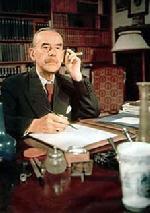
Thomas Mann, de jongere broer van Heinrich Mann, werd geboren op 6 juni 1875 in Lübeck. Hij was de tweede zoon van de graankoopman Thomas Johann Heinrich Mann welke later één van de senatoren van Lübreck werd. Zijn moeder Julia (geboren da Silva-Bruhns) was Duits-Braziliaans van Portugees Kreoolse afkomst. In 1894 debuteerde Thomas Mann met de novelle "Gefallen". Toen Thomas Mann met 21 jaar eindelijk volwassen was en hem dus geld van zijn vaders erfenis toestond - hij kreeg ongeveer 160 tot 180 goldmark per jaar - besloot hij dat hij genoeg had van al die scholen en instituties en werd onafhankelijk schrijver. Kenmerkend voor zijn stijl zijn de ironie, de fenomenale taalbeheersing en de minutieuze detailschildering. Manns reputatie in Duitsland was sterk wisselend. Met zijn eerste roman, Buddenbrooks (1901), had hij een enorm succes, maar door zijn sceptische houding tegenover Duitsland na de Eerste Wereldoorlog veranderde dit volledig. Stelde hij zich tot aan de jaren twintig apolitiek op (Betrachtungen eines Unpolitischen, 1918), meer en meer raakte hij bij het Politiek gebeuren betrokken. Zijn afkeer van het nationaal socialisme groeide, zijn waarschuwingen werden veelvuldiger en heftiger. In 1944 accepteerde hij het Amerikaanse staatsburgerschap. Tussen 1943 en 1947 schreef Mann Doktor Faustus (zie Faust), de roman van de 'Duitse ziel' in de gecamoufleerd geschilderde omstandigheden van de 20ste eeuw. In 1947 bezocht hij voor het eerst sinds de Oorlog Europa, twee jaar later pas Duitsland. In 1952 vertrok hij naar Zwitserland. Op 12 augustus 1955 stierf hij in Zürich. Twintig jaar na zijn dood, in aug. 1975, is zijn literaire nalatenschap geopend: dagboekaantekeningen van 15 maart 1933 tot 29 juli 1955, alsmede notities uit de jaren 1918 tot en met 1921.Belangrijke werken zijn: Der Zauberberg, Der Tod in Venedig, Dokter Faustus , Joseph und seine Brüder en Die Bekenntnisse des Hochstaplers Felix Krull.
Rainer Maria Rilke
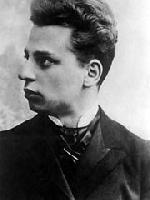
Rilke werd op 4 december 1875 geboren in Praag. Hij had al naam gemaakt als dichter met zijn bundels Das Stundenbuch en Das Buch der Bilder, toen hij de literaire wereld versteld deed staan en wereldfaam verwierf met de publicatie van zijn twee delen Neue Gedichte in 1907 en 1908. Hij verzamelde daarin het beste werk uit een van zijn vruchtbaarste periodes, die hij grotendeels doorbracht in Parijs. Rilke was daar diep onder de indruk gekomen van Rodin, bij wie hij een tijdlang in dienst was als particulier secretaris. Rodin, zei hij later, had hem leren kijken. Dit kijken kwam neer op intense concentratie, om het mysterie te kunnen zien ‘achter de schijnbare werkelijkheid'. Latere en rijpere werken als Duineser Elegien (1912-1923) en het ronduit schitterende Die Sonette an Orfeus (1924) illustreren Rilkes metafysische visie op het onzegbare, dat haar verwoording vindt in een hermetische muzikale taal. Op 29 december 1926 overlijdt Rilke in het sanatorium in Val-Mont aan de gevolgen van leukemie. Enkele dagen later wordt hij, overeenkomstig zijn wens, begraven op het kerkhof van Raron.
* * * * * * * * * * * * * * * *
Romenu
Over literatuur, gedichten, kunst en cultuur
05-11-2016
Ella Wheeler Wilcox, Hans Sachs, Ulla Berkéwicz, Mikhail Artsybashev, James Elroy Flecker, Washington Allston
I knew that a baby was hid in that house, Though I saw no cradle and heard no cry; But the husband was tip-toeing 'round like a mouse, And the good wife was humming a soft lullaby; And there was a look on the face of the mother, That I knew could mean only one thing, and no other.
The mother, I said to myself, for I knew That the woman before me was certainly that; And there lay in a corner a tiny cloth shoe, And I saw on a stand such a wee little hat; And the beard of the husband said, plain as could be, 'Two fat chubby hands have been tugging at me.'
And he took from his pocket a gay picture-book, And a dog that could bark, if you pulled on a string; And the wife laid them up with such a pleased look; And I said to myself, 'There is no other thing But a babe that could bring about all this, and so That one thing is in hiding somewhere, I know.'
I stayed but a moment, and saw nothing more, And heard not a sound, yet I know I was right; What else could the shoe mean that lay on the floor, The book and the toy, and the faces so bright; And what made the husband as still as a mouse? I am sure, very sure, there's a babe in that house.
Ella Wheeler Wilcox (5 november 1850 – 30 oktober 1919)
1. Eins morgens ging ich ausspaziren, um einen grünen walt refiren, da hört ich ein heimlich gesprech; in einem busche in der nech tet ich durch das gestreus mein schauen: da saß ein gsell bei einer frauen. Ich lost zu irem freuntling sagen, da war es nichts, wan bitter klagen. das freulein senlich in ansach und seufzent zu dem jüngling sprach: »herzlieb, wie sich ich dich so selten? sag mir doch, was muß ich entgelten?« Der jüngling fing widerum an: »vil geng ich dir zu lieb hab tan und dich doch nit ersehen kunde; des weinet ich von herzen grunde, dacht, dein huld ich verloren hab, all freuntschaft die wer tod und ab. die eifersucht brach mir das herz, die sensucht bracht mir heimlich schmerz.
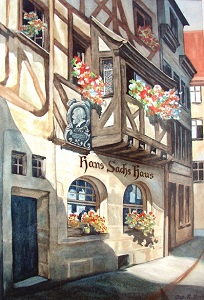
Hans Sachs (5 november 1494 -19 janauari 1576) Hans Sachs Haus in Neurenberg. Aquarel door A. Bauer
„…während die Swatch zu schlagen anfängt während sie aus der Tür schlägt, was nicht ins Haus gehört während die letzten sich geschlagen geben, der Wind auf Sturm steht, die Sturmgardinen wehn, die Polenmädchen vor dem Bettrand knien während die Hand tickt und es stürmt im Haus, die Swatch wehtut, die Polenmädchenzöpfe stürmen während ich weiß, nur weil er nicht mehr ist, kann es ihm ähnlich sehn, und ihm das Laken übern Kopf hochziehe, so daß die schönen großen Füße, die Füße, deren Nägel ich geschnitten habe, die Nägel, die jetzt weiterwachsen, ohne daß ich sie weiterschneiden kann, die weiterwachsen wie der Bart, obwohl wir endlich einen Türken haben, der gut balbiert während die schönen großen Füße da sind, fängt alles an, ohne ihn zu sein. 1 Die Angst, die ich immer noch habe, ist die, zu vergessen. Vergessen ist Verlieren, ist Verlorensein. Wir wissen nicht, was das Leben ist, noch was der Tod, wissen nicht, was wir selbst sind oder bleiben, sind außerstande, unsere Verwandlung in ein gottverlassenes Ding, in einen baren Stoff, in einen Leichenstein zu fassen, zu ergründen, schauen uns als Spieler im Spiegel, eh wir Maske machen und begreifen: Ich bin, der Ich bin, und der ist nicht von dieser Welt, denn die genügt mir nicht, mich dem, der Ich ist, zu erklären. Doch sitzt die Maske, wird der Spiegel zugehängt, und unser Zeitraum bläht sich, nimmt uns ein, bis wir vergessen, daß wir wußten, und nicht mehr wissen, daß wir vergessen haben. Vergessen, heißt es, sei die Vertreibung aus dem Paradies, von dem uns nur ein Staub geblieben, ein Goldstaub und ein hartes Sehnen bloß. Und weiter heißt es, im Sündenfall hätten wir einander in unsrer Nacktheit erst erkannt und davon, heißt es, erst gewußt, daß wir den Tod zu erwarten haben. Der Tod hat es mir angetan, von meinem Anfang an. Durch die kahlen Krankengänge tanzte ich an des Vaters Arzthand, tanzte in die Sterbezimmer ein, tanzte, sang, wollte mich leersingen für die Sterber, austanzen, ihnen meine jungen Jahre unter die alte Haut tanzen.“
“It so happened that the second platoon of the third squad of the Ashkadar regiment found itself completely cut off from the main body of the army, and this without the loss of a single cartridge or soldier. How this came about, and why a group of men, fifteen or twenty strong, had suddenly become an independent fighting unit, none of them could tell. At the outset, the entire Ashkadar regiment zealously trudged throughout the long autumn night along an interminable road, leading no one knew where, into the dark, damp, and hostile distance. To smoke or to converse was forbidden. In the dark, the black mass of the regiment, bristling with its bayonets like some huge, porcupine-like creature, crawled steadily onward, filling the air with the shuffling of innumerable feet. The men kept stumbling over each other, and swore viciously in half tones; they slipped in the mud and sank knee-deep into the wheel-tracks filled with cold water. "Some road!" they sighed quietly. At dawn the regiment was brought to a halt and was stretched along the edge of a wide potato field, which the soldiers had never seen before. It was drizzling with sickening persistence, and the dark-blue distances, mildly sloping and mournful, were blurred in the haze of the rain. On both sides, as far as eye could reach, ranks of grey officers and soldiers were wretchedly soaking in the rain. Water was dripping from their sullen faces and it looked as though they were all weeping over their fate—the fate which had cast them upon this strange, unknown, God-forsaken field. In a few hours many of them will perhaps be lying dead amidst the half-rotted potato stems on the wet soil with their pallid faces upturned to the cold heavens, the very ones which now weep also over their dear, distant country. Behind, a battery crew was vainly attempting to set the cannon which were sinking into the soaked plough-land. One could hear the hoarse angry voices, the cracking of whips, and the heavy, strained snorting of horses. In front of them lone officers wandered in drenched cloaks in the rain; still farther behind the curtain of rain and the thick fog there rumbled cannons and it was impossible to tell whether they belonged to the enemy or not. At times the shooting seemed to come from afar-off on the right. Then the rumble of the guns was deep and muffled like the sound of heavy iron balls rolling over the ground; at other times, the discharges were quite near and rent the air with a crash, bursting over the men's very heads, as it were.”
Mikhail Artsybashev (5 november 1878 – 3 maart 1927)
I rose from dreamless hours and sought the morn That beat upon my window: from the sill I watched sweet lands, where Autumn light newborn Swayed through the trees and lingered on the hill. If things so lovely are, why labour still To dream of something more than this I see? Do I remember tales of Galilee, I who have slain my faith and freed my will? Let me forget dead faith, dead mystery, Dead thoughts of things I cannot comprehend. Enough the light mysterious in the tree, Enough the friendship of my chosen friend.
Mignon
Knowest thou the land where bloom the lemon trees, And darkly gleam the golden oranges? A gentle wind blows down from that blue sky; Calm stands the myrtle and the laurel high. Knowest thou the land? So far and fair! Thou, whom I love, and I will wander there. Knowest thou the house with all its rooms aglow, And shining hall and columned portico? The marble statues stand and look at me. Alas, poor child, what have they done to thee? Knowest thou the land? So far and fair. My Guardian, thou and I will wander there.
Knowest thou the mountain with its bridge of cloud? The mule plods warily: the white mists crowd. Coiled in their caves the brood of dragons sleep; The torrent hurls the rock from steep to steep. Knowest thou the land? So far and fair. Father, away! Our road is over there!
James Elroy Flecker (5 november 1884 – 3 januari 1915)
Ah, then how sweetly closed those crowded days! The minutes parting one by one like rays, That fade upon a summer's eve. But O, what charm or magic numbers Can give me back the gentle slumbers Those weary, happy days did leave? When by my bed I saw my mother kneel, And with her blessing took her nightly kiss; Whatever Time destroys, he cannot this;- E'en now that nameless kiss I feel.
The French Revolution
The Earth has had her visitation. Like to this She hath not known, save when the mounting waters Made of her orb one universal ocean. For now the Tree that grew in Paradise, The deadly Tree that first gave Evil motion, And sent its poison through Earth's sons and daughters, Had struck again its root in every land; And now its fruit was ripe,-about to fall,- And now a mighty Kingdom raised the hand, To pluck and eat. Then from his throne stepped forth The King of Hell, and stood upon the Earth: But not, as once, upon the Earth to crawl. A Nation's congregated form he took, Till, drunk with sin and blood, Earth to her centre shook.
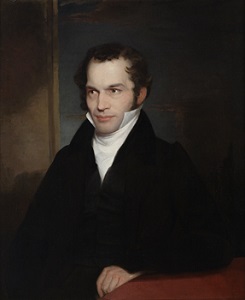
Washington Allston (5 november 1779 – 9 juli 1843) Portret door Charles Robert Leslie, z.j.
De Russische dichter en beeldend kunstenaar Dmitri Aleksandrovitsj Prigov werd geboren in Moskou op 5 november 1940 als zoon van een ingenieur en een pianiste. Zijn tienerjaren beleefde hij tijdens de periode van de Dooi onder Chroesjtsjov. Na het afmaken van de middelbare school werkte hij enige tijd als slotenmaker in een fabriek. In 1957 begon Prigov met het schrijven van poëzie, die later niet alleen in Rusland, maar ook in het Westen als samizdat circuleerde. In 1959 begon hij met een opleiding in de beeldhouwkunst aan de Stroganov staatsuniversiteit voor commerciële kunst van Moskou, waar hij van af werd gestuurd ten tijde van Chroesjtsjovs aanval op formalistische en abstracte kunst. Een jaar nadat hij van het instituut verwijderd was, mocht hij weer terugkomen en in 1966 studeerde hij alsnog af. Van 1966 tot 1974 werkte hij als stadsarchitect van Moskou. Tegelijkertijd hield hij zich ook met multi-media installaties, beeldhouwkunst, toneel, het schrijven van essays, schilderkunst, design, illustratie, muziek en grafische kunst bezig. Prigovs literaire werk werd voor het eerst gepubliceerd in de tweede helft van de jaren 70 in Slavische tijdschriften die in het Westen gepubliceerd werden - pas na 1986 werd zijn werk ook in de Sovjet-Unie uitgegeven. Vanaf het einde van de jaren 60 tot in de jaren 70 maakte Prigov deel uit van de underground beweging in Moskou. Hierin ontwikkelde hij zich tot een leidende figuur in de Moskouse beweging van het conceptualisme. In 1975 werd hij lid van de Kunstenaarsbond van de USSR, hoewel het nooit tot een tentoonstelling van zijn werk in de Sovjet-Unie kwam. In 1986 werd Prigov door de KGB gearresteerd tijdens een straatperformance en naar een psychiatrisch ziekenhuis gestuurd, maar na felle protesten, onder andere van dichteres en essayiste Bella Achmadoelina, werd hij snel weer vrijgelaten. Na het inzetten van de glasnost in 1987 werden vele exposities van zijn werk georganiseerd, zoals op de Documenta te Kassel en in 1989 in de “Struve Gallery” in Chicago, waarmee hij internationale bekendheid verwierf. Ook in de Sovjet-Unie werden nu exposities van Prigovs werk georganiseerd en in 1993 ontving hij de Poesjkin-prijs. Als freelance schrijver bevond hij zich afwisselend in Rusland, de Verenigde Staten en Duitsland.
Uit: Difficult Childhood or 20 Dreadful Tales (Vertaald door Chris Mattison)
(1) When I was young and played violin amidst a great hall a rat crept out from behind and crawled up my pant leg nibbling away at my trembling scrotum until it had nibbled it completely away and I played, played, played, and I played in the midst of the enormous, dank hall
(3) A merry old woman who lived near by Dropped everything and stopped in to visit Sitting and laughing, forgetting everything Her lower dentures flapping and flapping The two of us laughing faintly and idiotically I look — every tooth in her mouth Brand-new And mine — bare! And bleeding incessantly as well
(9) I remember, laying in bed sick And a whitish light running to me Cuddling up in my legs like it was playing Like a thousand gentle squeezes With such fervor Passed through me and disappeared into my sole I grasped it by the hair — ah! But it had no hair Everything fled through my sole
De fantasieën die ik vroeger als ik ziek was had! Filosofie, polyandrie, Andalusië, wat al niet, en nu? Ik zou de bladeren weer aan de takken willen hangen. Tweemaal daags wankel ik door de gang.
Navy Blue
Kom laat mij je kietelen, befietelen, vergiechelen, het is geen oorlog meer. Ook is het haast geen winter meer, geen winterweer geen onderweer No underwear wanted.
Kom laat mij je bepoedelen verloederen bemoederen, ik heb je geld geteld Change, Cambio, en je bent welgesteld. Ik heb mijn zaken op wèl gesteld, niet voor niets, niets voor niets.
Kom laat ik je bespelen, bestelen bestrelen, terecht of onterecht zijn wij terecht gekomen. Te recht of te krom, wie geeft er om? Echt is but real in reality.
Doe wel en zie niet om.
JIDDISH
Mijn vader zong de liedjes die zijn moeder vroeger zong later voor mij, die ze half verstond.
Ik zing dezelfde woorden weer heimwee fladdert in mijn keel heimwee naar wat ik heb.
Zing voor mijn kinderen wat ik zelf niet versta zodat zij later, later?
Voor de rozen verwelkt zijn drinken wij al het bloemenwater.
Verdrietige intieme taal het spijt me dat je in dit hoofd verschrompelde. Het heeft je niet meer nodig maar het mist je wel.
“Als het even kan vermijd ik gesprekken over geld, maar nu ze brak is durf ik het wel aan. We gebruiken samen haar Spaanse bankrekening, op mijn Nederlandse rekening sta ik tweeduizend euro rood. ‘Arturo, ik heb het gisteren gecheckt, er staat nog maar vierhonderd euro op, en daar moeten de bustickets naar Paraguay nog vanaf.’ Carmen was een peuter toen haar ouders uit elkaar gingen. Louise, de moeder van Carmen, is een Française uit Parijs. Louise bleef alleen achter met Carmen, haar twee jaar oudere broer Pelayo en haar zes jaar oudere zus Juliette. Louise kon ternauwernood haar gezin onderhouden en werkte zich het schompes. Jaime, Carmens vader, betaalde wel het paardrijden, skien, golfen en de Franse nonnenschool in Madrid. Noblesse oblige. Carmen is nog steeds doodsbang om ook maar een cent rood te staan, ik weet niet beter dan dat ik in de min sta. Zus Juliette heeft haar jeugdtrauma voortvarend aangepakt en is met de op een na rijkste man van Spanje getrouwd. (Nummer een was al bezet.) Carmen heeft mij. Komt tijd, komt raad, Carmencita.' Ik kalmeer Carmen op mijn gebruikelijke laconieke wijze: dat we allebei snel een baantje zullen vinden in Asuncion, dat mijn reisgids een bestseller gaat worden en dat ze in uiterste nood haar zus kan bellen. Echt overtuigend klinkt het niet, ik hoor mijzelf zwetsen. 'Kom, laten we naar die ecologische troep gaan. ik word een beetje duizelig van die kokosnoot, ik kan wel wat beweging gebruiken, lieverd.' Na een kwartier bereiken we de Baia dos Golfinhos. in de baai is geen dolfijn te bekennen, ook de door Lonely Planet beloofde zeeschildpadden laten het afweten. Vrijwel alle badgasten hebben de backpackersbijbel opzichtig naast zich liggen, als een herkenningsteken. Ik turf drie meisjes die Paulo Coelho lezen en vang flarden van een gesprek op tussen twee Amerikanen. Een knul met een sik, een zonnebril met oranje glazen en een T-shirt van de Pittsburgh Pirates: 'Dude, je moet naar het Madeiro-strand voor dolfijnen.”
Ich fahr durch Schnee und weiße Nacht. Der D-Zug rauscht. Der Schneesturm kracht. Ich press ans Fenster mein Gesicht: O Himmelslicht! O Himmelslicht!
Und blank entsteigt dem dunklen Wald Des ewigen Baumes Lichtgestalt. Der Schleier fällt vom Firmament, Und Sonne, Mond und Stern entbrennt.
Die Weihnacht hat uns hart beschert: Blutedelstein und Eisenschwert. In Tränen spielt das heilige Kind Mit Donnerklang und Wolkenwind.
Der finstre Geist herrscht überall, Des Kindes Spiel bringt ihn zu Fall. Die Sehnsucht ist sein Angesicht: O Himmelslicht! O Himmelslicht!
Mein Urenkel hat mich verstoßen
Mein Urenkel hat mich verstoßen, Mein Vater sich geweigert, Mich zu zeugen. Es ist Um Süßwasserpolyp zu werden Sein Innerstes Nach außen zu stülpen.
Mit den Herzen - zu verdauen Mit der Galle - zu träumen Mit dem Magensafte Seele zu sabbern.
An der Flussmündung
Die Wellen im Mondlicht glänzen wie tausend Fische Auf dem Wege zum Meer. Ich treibe im Kahn und mit dem Ruder wische Ich zärtlich einige Lotosblüten zu mir her. Mich schmerzt ein jeder Atemzug - das Heute wie das Gestern. Ich fluche meinem Ruhm, dem Wein, dem Fraß, den goldnen Tressen. Da haben die Lotosblumen im Winde zu flüstern sich vermessen: Vergiß die Traurigkeit! Wir sind dir gut wie Schwestern!
Klabund (4 november 1890 – 14 augustus 1928) Cover
“I saw a pretty one go by the other day. Yellow as a canary and trimmed with polished brass. It had a windshield like an oversized monocle, and it went ripping by at a speed that must have been close to a mile a minute. The end of the driver’s red scarf flagged straight out behind him, three feet long. I hated the racket and the dust that hung in the air long after the automobile was gone. But if I was twenty, I’d probably be trying to find out where you buy one of those fast bastards. The night has become electrified. Midevening, May comes to my room. The turn of doorknob, click of bolt in hasp. The opening door casts a wedge of yellow hall light against the wall. Her slender dark hand twists the switch and closes the door. Not a word spoken. The brutal light is message enough. A clear glass bulb hangs in the center of the room from a cord of brown woven cloth. New wires run down the wall in an ugly metal conduit. The bare bulb’s little blazing filament burns an angry cloverleaf shape onto my eyeballs that will last until dawn. It’s either get up and shut off the electricity and light a candle to read by, or else be blinded. I get up and turn off the light. May is foolish enough to trust me with matches. I set fire to two tapers and prop a polished tin pie plate to reflect yellow light. The same way I lit book pages and notebook pages at a thousand campfires in the last century. I'm reading The Knight of the Cart, a story I’ve known since youth. Lancelot is waiting where I left him the last time. Still every bit as anguished and torn about whether to protect his precious honor or to climb onto the shameful cart with the malefic dwarf driver, and perhaps by doing so to save Guinevere, perhaps have Guinevere for his own true love. Choosing incorrectly means losing all. I turn the pages and read on, hoping Lancelot will choose better if given one more chance. I want him to claim love over everything, but so far he has failed. How many more chances will I be able to give him?”
Uit:Balsamic Dreams: A Short but Self-Important History of the Baby Boomer Generation
“In the end, Baby Boomers didn't deliver on any of their promises. Instead, they were a case study in false advertising. They professed to go with the flow, but it was actually the cash flow, and they most certainly did not teach their children well, as they were too busy videotaping them. Instead, they took a dive. They retreated into the deepest recesses of their surprisingly tiny inner lives. They became fakes, hypocrites, cop-outs and, in many cases, out-and-out dorks. And the worst thing was: Most of them didn't realize it. Certainly not Mr. Dog Guy. One day last summer I was sitting on the veranda of my elegant, well-appointed house overlooking the Hudson River when a Jeep Grand Cherokee drifted past with a twee Alaskan malamute trotting about twenty yards behind. As the Jeep inched up the street at about five miles an hour, the dog meekly scurried along in its wake, occasionally soiling people's lawns. The dog and the vehicle soon disappeared around a bend in the road, but five minutes later they were back for the return leg of their little jaunt. When the dog attempted to do his business on my wife's beloved flower bed, I made it my business to scare him away with a stick. The dog clambered off and that was that. Over the course of the next three weeks, I observed the Jeep and the dog making their rounds early in the morning and late in the evening. The driver, about forty-five, was not from the neighborhood. Neither was the dog. The dog usually had the good sense to stay away from my lawn, but he invariably managed to take a dump somewhereelse. The two quickly became a kind of local legend. Everyone felt sorry for a pet unlucky enough to have an owner who was too lazy to get out of his car and actually walk the poor mutt. Everyone wondered what kind of a creep would own a beautiful dog like that and not only refuse to walk it, but refuse to clean up after it, and who would then compound that offense by driving to someone else's neighborhood and encouraging his dog to defecate all over strangers' properties. My neighbors proclaimed him a creep, a lowlife, a swine, not to mention a very thoughtless and insensitive human being."
Stalking the corridors of life, Black, frustrated minds Scream for release From Christian racist moulds. Moulds that enslave Black independence.
Take care! White racists! Black can be racists too. A violent struggle could erupt And racists meet their death.
Colour, the gift of nature To mankind, Is now the contentions bone, And black-white hatred sustains itself on the rotting, putrid flesh That once was man.
An Appeal
Statesmen, who make the nation's laws, With power to force unfriendly doors, Give leadership in this our cause That leaders owe.
Writers, who have the nation's ear, Your pen a sword opponents fear, Speak of our evils loud and clear That all may know.
Unions, who serve democracy, Guardians of social liberty, Warm to the justice of our plea, And strike your blow.
Churches, who preach the Nazarene, Be on our side and intervene, Show us what Christian love can mean Who need it so.
The Press, most powerful of all, On you the underprivileged call: Right us a wrong and break the thrall That keeps us low.
All white well-wishes, in the end On you our chiefest hopes depend; Public opinion's our best friend To beat the foe.
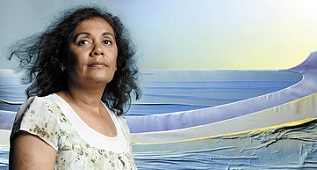
Oodgeroo Noonuccal (3 November 1920—16 September 1993)
Ze hebben nooit op haar geleken, daar heeft het altijd aan geschort. Ze hebben nooit op haar geleken, dus kwam hij steeds aan hen te kort.
Soms was het om hun mooie ogen, hun mooie lichaam of hun stem, hij heeft ze ook wel eens gemogen en dikwijls hielden ze van hem. Maar in de radeloze uren voor elke nieuwe grijze dag, dan lag hij in de nacht te turen en haatte wie er naast hem lag.
Ze hebben nooit op haar geleken, ze zijn gekomen en gegaan. Ze hebben nooit op haar geleken, dat heeft hij zich nooit toegestaan.
Hij kon hun warmte niet verdragen en zij niet altijd zijn verdriet, hij heeft ze er wel om geslagen, maar van hen houden kon hij niet. Toch hadden ze hem veel te geven, zelfs waar hij altijd overvroeg, een enkele haar hele leven, maar dat was hem niet eens genoeg.
Ze hebben nooit op haar geleken, al kwamen sommigen een end. Ze hebben nooit op haar geleken en haar heeft hij nooit echt gekend.
Uit:Voices of Silence (Vertaald door Stuart Gilbert)
“Once the masterpiece has emerged, the lesser works surrounding it fall into place; and it then gives the impression of having been led up to and foreseeable, though actually it is inconceivable — or, rather, it can only be conceived of once it is there for us to see it. It is not a scene that has come alive, but a latent potentiality that has materialized. Suppose that one of the world's masterpieces were to disappear, leaving no trace behind it, not even a reproduction; even the completest knowledge of its maker's other works would not enable the next generation to visualize it. All the rest of Leonardo's oeuvre would not enable us to visualize the Mona Lisa; all Rembrandt's, the Three Crosses or The Prodigal Son; all Vermeer's, The Love Letter; all Titian's, the Venice Pietà; all medieval sculpture, the Chartres Kings or the Naumburg Uta. What would another picture by the Master of Villeneuve look like? How could even the most careful study of The Embarkation for Cythera, or indeed that of all Watteau's other works conjure up L'Enseigne de Gersaint, had it disappeared? (...)
Each form of the sacrosanct was regarded by members of the culture which gave rise to it as a revelation of the Truth; at Byzantium it was not a mere hypothesis that was sponsored by the majesty of the Byzantine style. To us, however, these forms make their appeal as forms alone — in other words, as they would be were they the work of a contemporary (and, since this actually is unthinkable, they affect us in a puzzling manner); or else as so many grandiose vestiges of a faith that has died out. We look at them from outside; they are still emotive, but they are no longer true. Thus we deprive them of what was their most vital element; for a religious civilization that regarded what it revered as a mere hypothesis is inconceivable.”
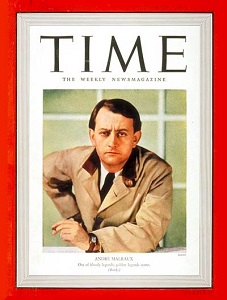
André Malraux (3 november 1901 – 23 november 1976) Cover Time, 1938
"Il y a quelque chose d’assez réjouissant à sortir, les premiers temps, quand on est… amoureuse. Comme l’autre jour au BHV, l’impression d’être la seule à connaître un secret. On promène un regard presque condescendant sur ce qui nous entoure, on sait qu’on est de passage, autre chose nous attend ailleurs. On se fout pas mal d’avoir l’air de faire tapisserie parce qu’en dedans, on est en conversation permanente avec soi-même, avec le souvenir de l’autre et la douce promesse d’être sur le point de le retrouver. Dans ces moments-là, on ne peut alors s’empêcher de détailler les autres. Les gens seuls, ceux qui traînent ça comme une fatalité, ceux qui se démènent. On étudie les couples qui ne sont plus de toute première fraîcheur. On imagine le sort qui les attend de retour chez eux, et on jubile à l’idée que nous, on sera bien plus intelligents… » (…)
« Au réveil suivant, en constatant qu’il est midi passé, tu es anéantie. Depuis toujours, tu dois te mettre au travail dès le matin. Tu n’as jamais pu t’expliquer pourquoi, mais si tu n’as pas la journée entière devant toi, une chape de plomb te tombe dessus et tu restes à regarder la journée filer sans trouver le moyen d’entrer dedans. Tu te sens alors comme paralysée, et à mesure que les heures passent, le dégoût qui te submerge devient si palpable, si épais, visqueux, gluant, que tu te retrouves empêtrée sans savoir comment t’en défaire. Même tendre la main pour allumer la télé demande un effort que tu ne peux fournir. Dans ces moments-là, tu as l’impression d’être aux prises avec ta vraie nature, à savoir une merde. Une merde incapable, qui ne mérite ni la confiance qu’on place en elle, ni l’argent dont on la couvre grassement, et les gens s’en rendront bien compte un jour, ce n’est qu’une question de temps."
„Die politische Iandkarte Italiens war im Mittelalter und der beginnenden Neuzeit ein Flickenteppich aus rivalisierenden Stadtstaaten und Fürstentiimern.die keine eigenen Armeen unterhielten. sondern ihre zahlreichen Rivalitäten und Kriege mit Söldnertruppen ausfochten. Deren Anflihrer. Condottieri genannt, waren häufig deutsche Ritter, die den Krieg nicht mehr als befristeten Lehensdienst fiir ihren feudalen landesherrn und die Whe verstanden. sondern ihren kriegerischen Ruhm für erfolgreiche geschäftliche Verhandlungen mit ihren Auftraggebern nutzten und ihre Truppe wie ein wirtschaftliches Unternehmen führten. Eine Humanisierung des Krieges bedeutete das nicht. Der blutige Nahkampf mit Spieß, Schwert. Keule und Bogen blieb ein grauenhaftes Spektakel, das Schlachtfelder voller Schwerverwundeter hinterließ, denen nicht mehr zu helfen war. Im englisch-französischen Krieg waren Kommandos walisisdner Messerstecher über das Feld gegangen, um das Leiden der Sterbenden mit geübten Stichen abzukiimen. Für die Bevölkerung des besiegten Landes waren die brutal ausgeübten Siegerrechte der Brandschatzung und Plünderung manchmal noch schlimmer zu ertragen als das Kampfgeschehen selbst. Da sich die Söldnerheere aus dem eroberten Land ernährten. wurden mit dem Recht des Stirkcren maßlos und ohne Rücksicht das Vieh und die Lebensmittelvorrlite geraubt. Mit Kriegsgefangenen. vor allem mit denen aus wohlhabenden Familien. wurden hohe Lösegelder erpresst. Das Drohpotenzial wurde immer weiter verfeinert und lebt weiter im mafiosen System der Schutzgelderpressungen.“
“Drei Tage vor meinem Tode schrieb ich eine Postkarte an die »Roten Radler«. – Ach so, diese Geschichte wollen ja auch die Berliner lesen! Die Berliner sind fein, sie sagen nicht Fahrstuhl, sondern Lift, sie sind »Gents« und beileibe keine »Herren«, und wenn sie etwas besorgen wollen, so schicken sie zum »Messenger-Boy-Institut«. Und daraus kann man schon ersehen, daß diese Geschichte nicht in Berlin passierte, denn ich schrieb meine Karte an die »Roten Radler«, weil das sehr hübsch klingt, und gar nicht an die »Messenger-Boys«, weil das ein ganz abscheuliches Wort ist. Meine Karte lautete: »Bitte, drei Tage nach Empfang dieser Karte, mittags um zwölf Uhr, eine Kiste zum Friedhofe zu besorgen. Die Gegenwart aller Roten Radler ist dabei erforderlich. Bezahlung und nähere Instruktionen liegen auf der Kiste.« Dann Name und Adresse. Die Roten Radler kamen pünktlich und mit ihnen kam der Herr Oberradler – in Berlin würde man sagen: der Messenger-Boy-Instituts-Vorsteher. Es war eine große lange Eierkiste, die sie holen sollten, und ich hatte mit vieler Mühe darauf gemalt: » Glas!« und » Zerbrechlich!« und » Vorsicht!« und » Nicht stürzen!«. In der alten Eierkiste lag natürlich meine Leiche, aber ich hatte den Deckel nicht zuschlagen lassen, weil ich durchaus eine »schöne Leich« sein wollte und daher aufpassen mußte, ob auch alles richtig besorgt würde. Der Oberradler nahm zuerst das Geld, das ich auf den Deckel gelegt hatte, und zählte es nach. »Fünfundvierzig Rote Radler«, sagte er, »für zwei Stunden – – es stimmt!« Er steckte das Geld in die Tasche und las nun meine Instruktion. »Nein,« sagte er dann, »das geht nicht! – das ist nicht unser Geschäft.« Ich machte meine Stimme recht dumpf und antwortete aus der Kiste: » Die Roten Radler besorgen alles!« Der Herr Oberradler wußte nicht recht, wer da gesprochen hatte, er kratzte sich an der Nase. »Meinetwegen,« sagte er, »meinetwegen!« Sein Gewissen schlug ihm; in all seinen Ankündigungen hieß es ausdrücklich: Die Roten Radler besorgen alles. Einer der Jungen wollte den Deckel zunageln, aber der Oberradler wies ihn zurück. »Fort!« rief er, auf den Zettel zeigend. »Hier heißt es ausdrücklich: der Deckel soll offen bleiben.« – Der Mann gefiel mir; nun er einmal die Besorgung angenommen, wich er um keinen Buchstaben von meiner Instruktion ab, die er noch einmal genau durchlas.“
Hanns Heinz Ewers (3 november 1871 – 12 juni 1943)
The stormy March is come at last, With wind, and cloud, and changing skies, I hear the rushing of the blast, That through the snowy valley flies.
Ah, passing few are they who speak, Wild stormy month! in praise of thee; Yet, though thy winds are loud and bleak, Thou art a welcome month to me.
For thou, to northern lands, again The glad and glorious sun dost bring, And thou hast joined the gentle train And wear'st the gentle name of Spring.
And, in thy reign of blast and storm, Smiles many a long, bright, sunny day, When the changed winds are soft and warm, And heaven puts on the blue of May.
Then sing aloud the gushing rills And the full springs, from frost set free, That, brightly leaping down the hills, Are just set out to meet the sea.
The year's departing beauty hides Of wintry storms the sullen threat; But in thy sternest frown abides A look of kindly promise yet.
Thou bring'st the hope of those calm skies, And that soft time of sunny showers, When the wide bloom, on earth that lies, Seems of a brighter world than ours.
William Cullen Bryant (3 november 1794 – 12 juni 1878) Portret door Samuel Morse, 1828-1829
Dolce far niente, Georg Heym, Charlotte Mutsaers, Désanne van Brederode, E. du Perron
Bij Allerzielen
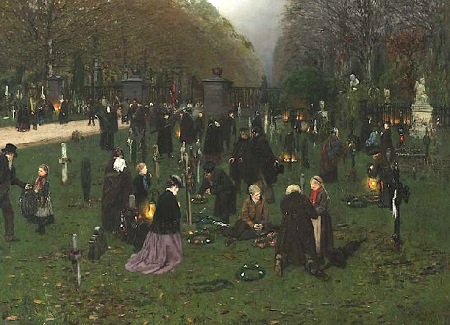
Allerseelen auf einem rheinischen Friedhof door Alfred Böhm, 1873
Allerseelen
Wie der Wind an eurem Kleide reißt Daß er die roten Blätter entführ. Wie ihr frierend duldet die Ungebühr. Kahl seid ihr bald, und bald verwaist.
Ein Lichtlein in euer Laub sich schmiegt. Eins erst. Bald sind es ihrer viel. Flackert hin, flackert her. Der Winde Spiel, Wie der Sterbenden geifernder Atem fliegt.
O du Toter, nun grüßen sie dich Zum letzten Mal. Bald hinab Mußt du nun wieder in Winters Grab. Warte noch, bleib, bis der Tag verwich.
Streife du noch in Novemberluft. Wenn Schnee erst fällt, deckt er zu Deinen Schlaf zu bitterer Winterrute. Winters Stürme gehen dann über die Gruft.
Hinter den Bäumen steht ihr. Ihr wärmt eure Hände. Rot fällt der Schein auf die weiße Lende. Bald gehn wir nun. Und einsam bleibt ihr.
Warum lächelt ihr? Euer Lächeln gleicht Einem Rätsel voll Bosheit und Dunkelheit, Wie wenn am Mittag in trüber Zeit Der Wind über Teiche im Moore streicht.
Wie ein Kind an die Ohren sich schlägt, Den Schall wiederholend, so tönt euer Laut, Wie das Sausen, wenn dunkel der Abend graut Und der Wind die zitternden Halme regt.
Ihr, die ihr nun aus Hierseins Schlafe erweckt, Die ihr nun eins seid mit Busch und Gras, Die den Tieren ihr gleicht, und dem, der genas Vom Lebenswahn, in Irrsinns-Stuben versteckt,
Ihr, sagt mir eins, warum schleicht ihr euch her. Ist es nicht besser, tot sein? Was steigt ihr herauf? Drängt an die Betten der Schläfer zuhauf, Mit Gerippen füllend der Träume Meer?
Ach, es muß einsam sein in des Todes Haus. Wenn die Erde friert bis zum Grunde hart. Und da kommt ihr nun, hohläugig starrt Ihr nach uns. Ihr unser, wir euer Graus.
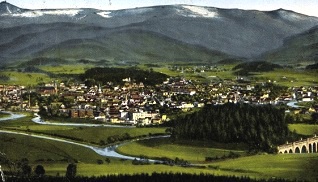
Georg Heym (30 oktober 1887 - 16 januari 1912) Hirschberg. Georg Heym werd geboren in Hirschberg
Met ponden draven ze op, met lires, dinars en goud en buidels vol kronen en franken, propvolle portemonnees passeren mijn brievenbus.
Hun spaarvarkens slaan ze kapot in rose gruzelementen. Pecunia mundi: voor mij! Karbonaden van platina, kaviaar met roebels erbij.
Giro's, inhalige cheques, hoogzwangere-ja-portefeuilles, shillings, de sol en de lev, escudo's, vergulde kroketten: dit alles vliegt mij maar aan.
Toch ben ik eenvoudig gewoon, al is mijn chateau niet van plastic. Wat is er met mij gebeurd dat al het slijk van de aarde geslingerd wordt door mijn raam?
Ben ik tot fiscus gevorderd, een schaap met dollars beslagen? Ik draag geen honing van achter en mijn eer die was al verkocht. Wat willen dan deze Richards?
Mijn hòndje willen ze kopen, masseren de plooi in zijn hals, begluren de goudbruine ogen, bekloppen zijn vachtloze buik en kussen de dropjesneus.
Ook smachten zij naar de tong om hun stinkende wonden te helen. Zij sabbelen graag aan de oren en tussen de stokjes van poten verlangen zij slapen te gaan.
Smijt uw brandkast maar dicht, houdt de stokoude aandelen binnen. Hondehart is niet te koop en de stevige staart evenmin. Voor geen enkel geld van de wereld.
“Alles was toeval, willekeur. Net als hijzelf. Even onbelangrijk als de hoofdletter A. Of: even belangrijk. Caspar keek naar de T, het dunne streepje van de I, het rondje dat een O moest voorstellen, en naar het getal 1 en het uitroepteken, die samen één toetsje moesten delen, en hij vroeg zich af of er op Spaanse computers en laptops een speciale toets zat voor het vraagteken-op-zijn-kop dat hij zo vaak in Spaanse teksten had gezien en waarvan hem de betekenis nooit duidelijk was geworden. Maar hij had er ook nooit iets over opgezocht, laat staan dat hij er iemand naar had gevraagd. Dertig jaar geleden, dus in de periode waarin hij aldoor maar dwangmatig had moeten eten, terwijl hij toch triestig mager was gebleven, was hij in de nacht van eerste op tweede kerstdag begonnen met wat hij het jaar erop al durfde te beschouwen als een geheime, zij het volkomen onschuldige eenpersoonstraditie. Het idee was simpel: eerst probeerde hij zich tot in detail zomaar een dag uit de voorbije zomervakantie voor de geest te halen. Hoe was hij wakker geworden, en waar? Wat had hij na het ontbijt ondernomen? Met wie? Wat had hij gezien, gehoord, geroken, geproefd, aangeraakt, gefantaseerd, gedacht? Had hij gefietst? Gezwommen? Gevoetbald, getennist, in gras of op een strand gelegen, op een handdoek, een deken, een ligstoel? Had er ergens muziek geklonken, had hij zijn walkman op gehad? Stond er ergens een radio aan, luisterde hij half-en-half mee met zijn vader, naar het verslag van een etappe van de Tour de France? Had hij een kruiswoordpuzzel gemaakt, een boek gelezen? Op de achterkant van een envelop een landschapje, een enkele plant of boom, een stripfiguurtje getekend, uit zijn hoofd, met balpen, gewoon om maar iets te doen te hebben? Om niet te veel te hoeven denken aan een bepaald meisje? Welk meisje? Meerdere meisjes? Een vrouw? Een lerares, een buurvrouw, iemand uit een winkel? Gingen ze een dag op stap? Kasteel, museum, pretpark, boottocht? “
‘Waarschijnlijk niet zoveel anders dan jij; ik haal ze ook uit de krant. Vraag mij liever wat ik van Parijs denk: de wereld is hier even onwezenlijk als waar ook. Heb je er enig besef van hoe de lichtreclames op ons inwerken, Ducroo; hoe ze ons kunnen beletten om bijvoorbeeld de maan te voelen? Heb je ooit voor jezelf kunnen uitmaken wat je precies denkt van de nieuwe lichtreclame op de Eiffeltoren: die gele kring om een wijzerplaat, met één wijzer die groen en één die geel is? Waarom weer geel? waarom deze wijzer niet rood, blauw, violet, wat toch eerlijker zou zijn geweest en precies even makkelijk te realiseren viel? Je denkt dat ik dit zeg om je te laten zien hoeveel fantasie ik heb? Helemaal niet, dit is gewoon een van die vele dingen die ik niet begrijp en die mij kwellen. Ik word gekweld omdat ik - hoe zal ik 't zeggen? - omdat ik nu de man zou willen kennen die met deze reclame belast werd. Maar er zijn ook dingen die ik niet begrijp en die mij niet kwellen; waaronder de krachten van deze tijd.’ Ik laat hem door mijn zwijgen voelen dat hij verder zou moeten gaan. Hij doet het. ‘Weet je wat ik nu denk? Dat dit tenslotte gewoonweg een frans mysterie is; dat ik, al word ik een oud man in Parijs, toch nooit een Fransman zal begrijpen. Een Rus had die ene wijzer ook een eigen kleur gegeven; je hoeft er niet aan te twijfelen als ik het je zeg.’ Hij is op het stokpaard geraakt waarop ik hem in drie ontmoetingen driemaal heb zien rijden. Wat hebben de Fransen hem aangedaan, of waarop berust deze behoefte om vooral Rus te zijn tegenover de Fransen? ‘Ik twijfel geen seconde.’ ‘Dat zeg je, en je voelt je als een Fransman tegenover mij. Geloof Héverlé niet als hij zegt dat je veel van een Fransman hebt; het is niet waar, je hebt er even weinig van als ik. Zeg maar eens eerlijk wat voor jou reëel is in deze omgeving.’ ‘Hoe meer je iets kent, hoe minder reëel het worden kan. Toen ik pas uit Indië kwam vond ik Marseille doodgewoon; ik dacht dat ik eindelijk in het land was waar ik thuishoorde; en dat niet alleen, maar ik kende ook de verdiepingwoningen, het totaal andere aanzicht van een straat, door de films die ik gezien had.”
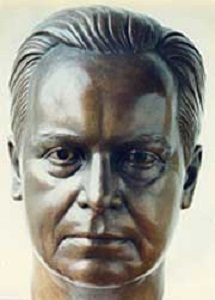
E. du Perron (2 november 1899 – 14 mei 1940) Bronzen hoofd door Sylvia Willink-Quiël
Dolce far niente, Franz Alfred Muth, Job Degenaar, Rudy Kousbroek, Huub Oosterhuis
Dolce far niente – Bij Allerheiligen
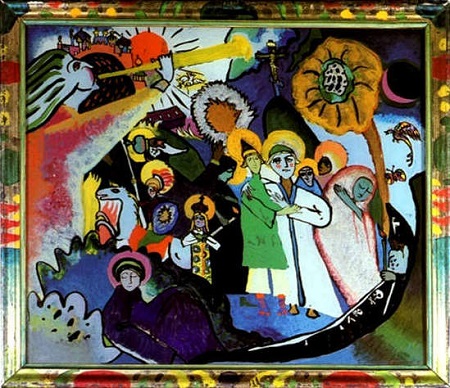
Allerheiligen 1 door Wassily Kandinsky, 1911
Allerheiligen
Selig, selig sind die Kindlein Ohne Arg und Falsch, die reinen, Selig Alle, die noch können Kindlich jubeln, kindlich weinen, Selig sind die Kinderherzen, Ob die Erde auch voll Schmerzen!
Selig, selig alle Herzen Arm und töricht vor der Erden, Sie, die lieben Weh und Schmerzen, Die sich freuen in Beschwerden; Sel`ge Thorheit vor der Erden, Ew`ge Weisheit wird dir werden.
Heil`ge Armut, die in Freuden Alles für den Herrn gegeben, O was reiche Seligkeiten Werden dein im andern Leben! Droben gibt es Edelsteine, Diese Welt, sie hat ja keine.
Wer verfolgt, gehaßt auf Erden Um der ew`gen Wahrheit willen, Selig, selig wird er werden, Gott wird schon die Tränen stillen. Wie`s nicht ahnen mag die Erden, Muß er selig, selig werden.
Alles wird der Herr vergelten, Was wir litten, was wir stritten, Seinen Duldern, seinen Helden In des Himmels ew`gen Hütten: Wie`s nicht ahnen kann die Erden, Werden alle selig werden.
Und auch du mußt selig werden, Ob im Kampfe, ob im Dulden; Auf das Herz von dieser Erden, Auf aus deiner Sünden Schulden! Willst du hoffen, lieben, sehnen, Selig, selig unter Tränen!
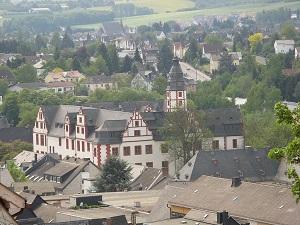
Franz Alfred Muth (13 juni 1839 - 3 november 1890) Hadamar met slot. Franz Alfred Muth werd geboren in Hadamar.
De Hongaarse dichter, schrijver, vertaler en letterkundige Szilárd József Borbélywerd geboren op 1 november 1963 in Fehérgyarmat. Szilárd Borbély stamde uit een arme (half-joodse) familie, de grootvader van vaders kant kwam om in concentratiekamp Auschwitz. Hij is opgegroeid in een dorp en studeerde na zijn militaire dienst. Hongaarse taal en literatuur aan de Lajos-Kossuth Universiteit in Debrecen. Hij werd in 1989 assistent aan de leerstoel Oude Hongaarse literatuur en was gespecialiseerd in de Hongaarse literatuur van de Barok en vroege 19e eeuw. In zijn studie Een Vanitatum vanitas szövegvilágáról (1995) onderzocht hij de poëzie van Ferenc Kölcsey. Hij promoveerde in 1998. In 1988 publiceerde hij zijn eerste gedicht “Adatok”. Borbély noemde Kafka, János Pilinszky, Miklós Mészöly, Péter Nádas en Péter Esterházy als referentiepunten van zijn poëtische werk. Borbély werkte als vertaler uit het Duits en Engels, o.a. werk van Rumjana Zacharieva, Monika Rinck, Hendrik Jackson, Robert Gernhardt en Durs Grünbein. Op het laatste bereidde hij een vertaling voor van “Europa erfindet die Zigeuner” van Klaus-Michael Bogdal, waarvoor hem een "Paul-Celan Fellowship" toegekend was. Borbély heeft tal van Hongaarse literaire prijzen ontvangen, waaronder de Tibor Déry-prijs, de József Attila-prijs en de Füst-Milánprijs. Bij een inbraak in het huis van zijn ouders, werd zijn moeder gedood, zijn vader werd ernstig gewond; Borbély verwerkte in “Halotti pompa” (2004) de gebeurtenissen poëtisch. Hij publiceerde in 2013 zijn eerste roman. Borbély leed aan depressies en pleegde zelfmoord op 19 februari 2014.
Im Körper zu leben
Im Laufe der Evolution menschlichen Verhaltens wurde die Sprache zum Mittel der Isolation. Denn parallel zur Welt der Gegenstände kann sich das Bewußtsein die Dinge vorstellen
durch geistige Vergegenwärtigung. Wenn sie auf- tauchen im Bewußtsein. Die Sprache ist die dritte Ebene der Repräsentation. Mit ihrer Hilfe kann auch in einem anderen Bewußtsein das Bild des Gegenstandes
vorgestellt werden. Auf dieser Stufe der Repräsentation kann die Erfahrung der Metaphern durch das Gespräch vermittelt werden. Und wenn sich die Liebenden des Nachts
treffen, berührt sich im Dunkeln ihr Geist. Denn das Dasein verfügt über eine höhere Dimension. Denn im Körper zu leben ist der Tod.
Letzte Dinge Die Ewigkeit
Dunst quillt in der Winterlandschaft auf, der leichte Rauch im Kesselhaus. Am Berghang blendet im Sonnenschein ein orthodoxer Friedhof wie der Stein,
der glühte, wie das geschmolzene Erz im Feuer und im Kessel gärt. So begann der Nachmittag zu fallen, wie mancher Engel vor der Bahnhofshalle
wartete, den Kopf über die Pfütze gesenkt, auf ein leichtes Mädchen, ein Gratisgetränk. Indes in den Bezirken am äußersten Ring die Zeit jetzt und für immer verging,
denn dort hielt man das Jüngste Gericht, und es kämpfte dabei Christ gegen Christ. Die Heiden hingegen tranken Cola light in einer Kneipe namens Ewigkeit.
Vertaald door Heike Flemming
Szilárd Borbély (1 november 1963 -19 februari 2014)
De Amerikaanse schrijverDon Winslowwerd geboren in New York op 31 oktober 1953. Hij groeide op in Perryville, een kustdorpje in South Kingstown, Washington County (Rhode Island)). Zijn moeder was een bibliothecaris en zijn vader was een onderofficier van de United States Navy. Winslow studeerde af in Afrikaanse Geschiedenis aan de Universiteit van Nebraska. Voordat hij schrijver werd had hij verschillende baantjes. Eind jaren 1970 verhuisde hij terug naar New York, waar hij werkzaam was als de manager van een bioscoopketen en als privédetective. Nadien ging hij terug naar school en behaalde hij een Masterdiploma in de richting Militaire Geschiedenis. Hij leidde ook safari's in Kenia en ondernam grote wandeltochten in de Chinese provincie Sichuan. In 1991 werd zijn debuutroman “A Cool Breeze on the Underground” uitgebracht. Het was tevens zijn eerste boek over het hoofdpersonage Neal Carey, een jonge, New Yorkse boekenwurm en privédetective. Midden jaren 1990 verhuisde Winslow met zijn gezin naar Californië. In 1997 bracht hij de roman”The Death and Life of Bobby Z” uit. Het boek werd een groot succes, hetgeen hem toeliet om voltijds schrijver te worden. Tien jaar later werd het boek verfilmd door regisseur John Herzfeld. In 2010 schreef Winslow de misdaadroman “Savages”. Het boek, over twee Amerikaanse drugsdealers die ruzie krijgen met een Mexicaans drugskartel, werd twee jaar later verfilmd door Oliver Stone. Winslow zelf schreef het scenario voor de verfilming.
Uit:The Cartel
„The bell rings an hour before dawn. The beekeeper, released from a nightmare, gets up. His small cell has a bed, a chair, and a desk. A single small window in the thick adobe wall looks out onto the gravel path, silver in the moonlight, which leads up toward the chapel. The desert morning is cold. The beekeeper pulls on a brown woolen shirt, khaki trousers, wool socks, and work shoes. Walking down the hall to the communal bathroom, he brushes his teeth, shaves with cold water, and then falls in with the line of monks walking to the chapel. No one speaks. Except for chanting, prayers, meetings, and necessary conversation at work, silence is the norm at the Monastery of Christ in the Desert. They live by Psalm 46:10—“Be still and know that I am God.” The beekeeper likes it that way. He’s heard enough words. Most of them were lies. Everyone in his former world, himself included, lied as a matter of course. If nothing else, you had to lie to yourself just to keep putting one foot in front of the other. You lied to other people to survive. Now he seeks truth in silence. He seeks God in the same, although he has come to believe that truth and God are the same. Truth, stillness, and God. When he first arrived, the monks didn’t ask him who he was or where he came from. They saw a man with saddened eyes, his hair still black but streaked with silver, his boxer’s shoulders a little stooped but still strong. He said that he was looking for quiet, and Brother Gregory, the abbot, responded that quietude was the one thing they had in abundance. The man paid for his small room in cash, and at first spent his days wandering the desert grounds, through the ocotillo and the sage, walking down to the Chama River or up onto the mountain slope. Eventually he found his way into the chapel and knelt in the back as the monks chanted their prayers.“
Dolce far niente, Henry Longfellow, Joseph Boyden, John Keats
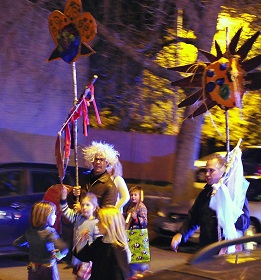
Bij Halloween
The Haunted House door John Atkinson Grimshaw, 1874
Haunted Houses
All houses wherein men have lived and died Are haunted houses. Through the open doors The harmless phantoms on their errands glide, With feet that make no sound upon the floors.
We meet them at the door-way, on the stair, Along the passages they come and go, Impalpable impressions on the air, A sense of something moving to and fro.
There are more guests at table than the hosts Invited; the illuminated hall Is thronged with quiet, inoffensive ghosts, As silent as the pictures on the wall.
The stranger at my fireside cannot see The forms I see, nor hear the sounds I hear; He but perceives what is; while unto me All that has been is visible and clear.
We have no title-deeds to house or lands; Owners and occupants of earlier dates From graves forgotten stretch their dusty hands, And hold in mortmain still their old estates.
The spirit-world around this world of sense Floats like an atmosphere, and everywhere Wafts through these earthly mists and vapours dense A vital breath of more ethereal air.
Our little lives are kept in equipoise By opposite attractions and desires; The struggle of the instinct that enjoys, And the more noble instinct that aspires.
These perturbations, this perpetual jar Of earthly wants and aspirations high, Come from the influence of an unseen star An undiscovered planet in our sky.
And as the moon from some dark gate of cloud Throws o’er the sea a floating bridge of light, Across whose trembling planks our fancies crowd Into the realm of mystery and night,—
So from the world of spirits there descends A bridge of light, connecting it with this, O’er whose unsteady floor, that sways and bends, Wander our thoughts above the dark abyss.
Henry Longfellow (27 februari 1807 - 24 maart 1882) West End Halloween Parade in Portland, Maine. Lomfellow wird geboren in Portland.
“They keep him on the top floor, the critical one. I can smell the raw scent of him. It lingers just under the soap of the birdbath his nurse Eva gave him earlier. I’m close to his ear, close enough to see a few grey hairs sprouting from it. “Can you hear me?” I’m gone eight months, then home for a day, only to have this happen. “Eva tells me to talk to you. I feel stupid, but I’ll try for a few minutes before Mum comes back. She can’t catch me, though.” She’d take it as a sign of me weakening, of finally becoming a good Catholic girl like she’s always wanted. I stand up, see white outside the window, a long view of the river and three feet of snow, the spruce like a wrought iron fence in black rows against the white. So cold out today. The sky is blue and high. No clouds to hold any heat. Dr. Lam wanted to fly him down to Kingston but was concerned he wouldn’t make the journey. He’ll die down there. I watch as snowmobiles cut along the river, following the trail from Moosonee.Their exhaust hangs white in the air. February. The deadest month. The machine that helps him breathe sounds like the even breath of some mechanical sleeping child. A machine hooked up to his arm beeps every second or so. I think it is the machine that tells the staff that his heart still beats. I hear the pad of footsteps entering the room and I turn, expecting my mother, black hair eight months ago mostly white now so that when I first saw her nothing made sense. But it’s Eva, so large in her blue scrubs, all chubby brown face. I always thought nurses wore white uniforms and silly-looking hats. But in this hospital they dress like mechanics. I guess that’s what they are. Eva checks his vitals and jots them down on his clipboard. She turns him on his side and places pillows behind to prop him up. She told me it is to prevent bedsores. A month now he’s been here and all they can tell me is he remains in a stable but deeply catatonic state. The chances are slim that he’ll ever wake again. The injuries to his head were massive, and he shouldn’t be alive right now. But is he really alive, lying there? I want to ask Eva as she rubs his legs. “Come help me, Annie,” she says. “Do the same to his arms. Keep the circulation going. It’s vital.” “Ever weird,” I say, standing on the other side of the bed, holding his arm in my hands, kneading it. “What is?” “Touching him. My whole life I can’t ever remember touching him at all.” “Get over it.” Eva breathes heavily as she works. She huffs and puffs. I’ve known her all my life and she’s always been fat. Bigger than fat. She is my apple-faced, beluga-sized best friend. “Have you been talking to him?” she asks.”
After dark vapors have oppress'd our plains For a long dreary season, comes a day Born of the gentle South, and clears away From the sick heavens all unseemly stains. The anxious month, relieved of its pains, Takes as a long-lost right the feel of May; The eyelids with the passing coolness play Like rose leaves with the drip of Summer rains. The calmest thoughts came round us; as of leaves Budding -- fruit ripening in stillness -- Autumn suns Smiling at eve upon the quiet sheaves -- Sweet Sappho's cheek -- a smiling infant's breath -- The gradual sand that through an hour-glass runs -- A woodland rivulet -- a Poet's death.
As from the darkening gloom a silver dove
As from the darkening gloom a silver dove Upsoars, and darts into the eastern light, On pinions that nought moves but pure delight, So fled thy soul into the realms above, Regions of peace and everlasting love; Where happy spirits, crown'd with circlets bright Of starry beam, and gloriously bedight, Taste the high joy none but the blest can prove. There thou or joinest the immortal quire In melodies that even heaven fair Fill with superior bliss, or, at desire, Of the omnipotent Father, cleav'st the air On holy message sent -- What pleasure's higher? Wherefore does any grief our joy impair?
To A Cat
Cat! who has pass'd thy grand climacteric, How many mice and rats hast in thy days Destroy'd? How many tit-bits stolen? Gaze With those bright languid segments green, and prick Those velvet ears - but prythee do not stick Thy latent talons in me - and tell me all thy frays, Of fish and mice, and rats and tender chick; Nay, look not down, nor lick thy dainty wrists, - For all the wheezy asthma - and for all Thy tail's tip is nick'd off - and though the fists Of many a maid have given thee many a maul, Still is thy fur as when the lists In youth thou enter'dst on glass-bottled wall.
John Keats (31 oktober 1795 – 23 februari 1821) Portret door William James Neatby (1860-1910).
Dolce far niente, Robert Frost, Jan Van Loy, Ezra Pound, Paul Valéry, Andrew Solomon
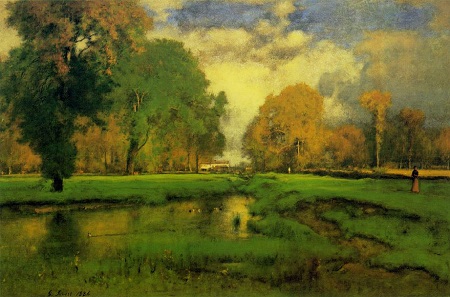
Dolce far niente
October door George Inness, 1886
October
O hushed October morning mild, Thy leaves have ripened to the fall; Tomorrow's wind, if it be wild, Should waste them all. The crows above the forest call; Tomorrow they may form and go. O hushed October morning mild, Begin the hours of this day slow. Make the day seem to us less brief. Hearts not averse to being beguiled, Beguile us in the way you know. Release one leaf at break of day; At noon release another leaf; One from our trees, one far away. Retard the sun with gentle mist; Enchant the land with amethyst. Slow, slow! For the grapes' sake, if the were all, Whose elaves already are burnt with frost, Whose clustered fruit must else be lost— For the grapes' sake along the all.
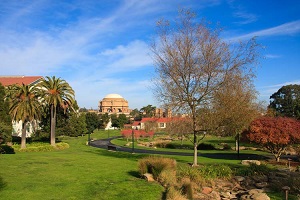
Robert Frost (26 maart 1874 – 29 januari 1963) Herfst in het Presidio park, San Francisco. Robert Frost werd geboren in San Francisco.
De Vlaamse schrijver Jan Van Loy werd op 30 oktober 1964 geboren te Herentals, in de Antwerpse Kempen. Zie ook alle tags voor Jan Van Loyop dit blog.
Uit: Ik, Hollywood
“Er was geen huis, geen poort, geen ankerplaats. Alleen een rij lage bomen, met daarachter meer van dezelfde bomen, allemaal in het gelid. Iedereen stapte uit. ‘Van wie is deze auto?’ vroeg Charlie. ‘Van mij,’ zei Mooney. ‘Van meneer Whitfield. Ik gebruik hem voor mijn werk.’ ‘En wat moeten wij doen als we ergens naartoe willen?’ ‘Daar rijdt een tram.’ Mooney wees naar het einde van de weg, waar niets bijzonders te zien was. Aan de overkant van de straat lag braakland, verderop stonden enkele bungalows. ‘Is er een drugstore?’ ‘Dáár,’ zei Mooney weer. ‘In de hoofdstraat.’ Hij ging tussen de bomen door een pad op. De broers volgden hem maar. ‘Citroen,’ zei Mooney, wijzend naar een boom. ‘Tweehonderdvijftig stuks. Verwaarloosd.’ Hij wees naar de talrijke hoopjes aarde. ‘Zakratten.’ Ze kwamen bij een open ruimte rondom een donkere houten constructie. ‘Het huis,’ zei Mooney. ‘Dat is een schuur,’ zei Charlie. ‘Ja, een schuur,’ zei Louie, hoewel hij alleen in de filmpjes ooit een schuur had gezien. ‘Een schuur heeft geen binnenmuren,’ zei Mooney. ‘Dit heeft drie kamers.’ ‘Het ziet eruit als een schuur,’ zei Charlie. ‘Iets voor vee.’ ‘Vee gaat in een stal,’ zei Mooney. ‘Een schuur is voor opslag. En dit is een huis.’ Ze gingen naar binnen. De vloerplanken hikten onder elke stap. Er stonden een tafel met vier stoelen en een dun gestoffeerde bank; in een hoek een onversierde ladekast. ‘Drie maanden woon ik hier,’ zei Mooney. ‘Valt mee.’ ‘Maar toch blij dat je nu kunt vertrekken?’ vroeg Louie.”
The ship landed in Scios, men wanting spring-water, And by the rock-pool a young boy loggy with vine-must, "To Naxos? Yes, we'll take you to Naxos, Cum' along lad." "Not that way!" "Aye, that way is Naxos." And I said: "It's a straight ship." And an ex-convict out of Italy knocked me into the fore-stays, (He was wanted for manslaughter in Tuscany) And the whole twenty against me, Mad for a little slave money. And they took her out of Scios And off her course... And the boy came to, again, with the racket, And looked out over the bows, and to eastward, and to the Naxos passage. God-sleight then, god-sleight: Ship stock fast in sea-swirl, Ivy upon the oars, King Pentheus, grapes with no seed but sea-foam, Ivy in scupper-hole. Aye, I, Acœtes, stood there, and the god stood by me, Water cutting under the keel, Sea-break from stern forrards, wake running off from the bow, And where was gunwale, there now was vine-trunk, And tenthril where cordage had been, grape-leaves on the rowlocks, Heavy vine on the oarshafts, And, out of nothing, a breathing, hot breath on my ankles, Beasts like shadows in glass, a furred tail upon nothingness. Lynx-purr, and heathery smell of beasts, where tar smell had been, Sniff and pad-foot of beasts, eye-glitter out of black air. The sky overshot, dry, with no tempest, Sniff and pad-foot of beasts, fur brushing my knee-skin, Rustle of airy sheaths, dry forms in the æther. And the ship like a keel in ship-yard, slung like an ox in smith's sling, Ribs stuck fast in the ways, grape-cluster over pin-rack, void air taking pelt. Lifeless air become sinewed, feline leisure of panthers, Leopards sniffing the grape shoots by scupper-hole, Crouched panthers by fore-hatch, And the sea blue-deep about us, green-ruddy in shadows, And Lyæus: "From now, Acœtes, my altars, Fearing no bondage, fearing no cat of the wood, Safe with my lynxes, feeding grapes to my leopards, Olibanum is my incense, the vines grow in my homage."
Ezra Pound (30 oktober 1885 - 1 november 1972) Portret door Rickie Dickerson, 2000
Un fruit de chair se baigne en quelque jeune vasque, (Azur dans les jardins tremblants) mais hors de l’eau, Isolant la torsade aux puissances de casque, Luit le chef d’or que tranche à la nuque un tombeau.
Éclose la beauté par la rose et l’épingle! Du miroir même issue où trempent ses bijoux, Bizarres feux brisés dont le bouquet dur cingle L’oreille abandonnée aux mots nus des flots doux.
Un bras vague inondé dans le néant limpide Pour une ombre de fleur à cueillir vainement S’effile, ondule, dort par le délice vide,
Si l’autre, courbé pur sous le beau firmament, Parmi la chevelure immense qu’il humecte, Capture dans l’or simple un vol ivre d’insecte.
L’abeille A Francis De Miomandre
Quelle, et si fine, et si mortelle, Que soit ta pointe, blonde abeille, Je n’ai, sur ma tendre corbeille, Jeté qu’un songe de dentelle.
Pique du sein la gourde belle, Sur qui l’Amour meurt ou sommeille, Qu’un peu de moi-même vermeille, Vienne à la chair ronde et rebelle!
J’ai grand besoin d’un prompt tourment: Un mal vif et bien terminé Vaut mieux qu’un supplice dormant!
Soit donc mon sens illuminé Par cette infime alerte d’or Sans qui l’Amour meurt ou s’endort!
Paul Valéry (30 oktober 1871 – 20 juli 1945) Zelfportret, 1924
“Depression is the flaw in love. To be creatures who love. we must be creatures who can despair at what we lose. and depression is the mechanism of that despair. When it comes. it degrades one’s self and ultimately eclipses the capacity to give or receive affection. It is the aloneness within us made manifest. and it destroys not only connection to others but also the ability to be peacefully alone with oneself. Love. though it is no prophylactic against depression. is what cushions the mind and protects it from itself. Medications and psychotherapy can renew that protection. making it easier to love and be loved. and that is why they work. In good spirits. some love themselves and some love others and some love work and some love God: any of these passions can furnish that vital sense of purpose that is the opposite of depression. Love forsakes us from time to time. and we forsake love. In depression. The meaninglessness of every enterprise and every emotion. the meaninglessness of life itself. becomes self-evident. The only feeling left in this loveless state is insignificance. Life is fraught with sorrows: no matter what we do. we will in the end die; we are, each of us, held in the solitude of an autonomous body; time passes. and what has been will never be again. Pain is the first experience of world-helplessness, and it never leaves us. We are angry about being ripped from the comfortable womb. and as soon as that anger fades. distress comes to take its place. Even those people whose faith promises them that this will all be different in the next world cannot help experiencing anguish in this one; Christ himself was the man of sorrows. We live. however. in a time of increasing palliatives; it is easier than ever to decide what to feel and what not to feel. There is less and less unpleasantness that is unavoidable in life. for those with the means to avoid. But despite the enthusiastic claims of pharmaceutical science. depression cannot be wiped out so long as we are creatures conscious of our own selves. It can at best be contained-and containing is all that current treatments for depression aim to do. »